
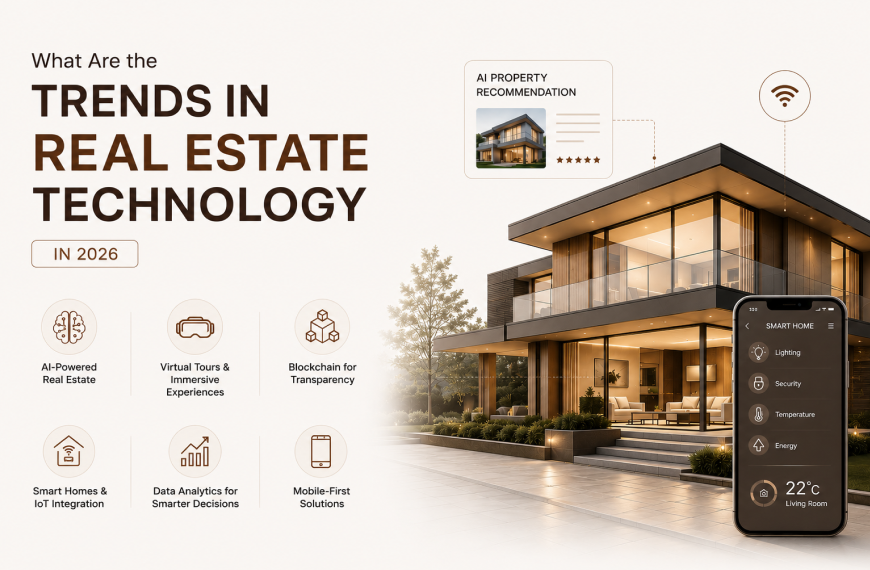
Your Agent Has an Agent Now: Real Estate Tech in 2026 Is Getting Wild
Somewhere between the interest rate rollercoaster of the last few years and this summer’s cautiously optimistic market, something quietly shifted in the real estate industry — and it’s not just mortgage rates or inventory counts. The technology underneath how homes get bought and sold is having a full-on identity crisis. And for buyers and sellers in Bartlett, Bloomingdale, and across the northwest suburbs, that matters more than you might think.
The AI Agent That Talks to Other AI Agents
The buzzword for 2026 isn’t “AI” anymore — it’s agentic AI. The difference is subtle but important. Last year’s AI could answer your questions. This year’s AI can go do things — run a search, pull comparable sales, flag a listing the moment it hits the market, and draft an offer timeline, all without being asked step by step.
According to recent industry analysis, agentic AI is one of the top five trends reshaping real estate technology right now, alongside predictive seller analytics, digital twins, drone data collection, and AI-enhanced CRMs. That’s a lot of acronyms and buzzwords, so let’s unpack what actually affects you if you’re thinking about buying or selling a home in Carol Stream or Schaumburg this summer.
What “Predictive Seller Analytics” Actually Means for You
This one is interesting — and a little eerie if you think about it too hard. Predictive seller analytics means that real estate platforms are now modeling which homeowners are likely to sell before those homeowners have even consciously decided to list. The algorithm looks at factors like how long someone has owned their home, life stage signals, neighborhood turnover rates, and even utility usage patterns.
For buyers, this is potentially great news. In tight markets like Hanover Park or Streamwood — where inventory has been frustratingly thin — this kind of technology can surface off-market opportunities that never make it to Zillow. For sellers, it means your mailbox (physical and digital) is about to get more targeted outreach from agents who have a very specific reason to believe you’re about to sell.
Digital Twins and the Virtual House Tour, Evolved
Remember when 3D virtual tours felt like a novelty during the pandemic? Now the industry is pushing into digital twins — essentially a living, data-connected virtual replica of a property. Not just a pretty walkthrough, but a model that can tell you the age of the HVAC system, the insulation R-value, and even simulate what happens to your energy bill if you add solar.
For buyers relocating to Elgin or looking at new construction in the Schaumburg corridor, this kind of tool can dramatically reduce the number of physical showings needed before making a serious offer. It’s not a replacement for walking through a home — nothing is — but it’s a serious upgrade from the 12 blurry photos and a floorplan we used to call a “listing.”
Drones Are Now a Standard Tool, Not a Flex
A few years ago, drone footage on a listing felt like a luxury reserved for $800K+ properties. In 2026, drone data collection has become a standard part of how top teams assess and market properties — including neighborhood context, lot lines, roof conditions, and proximity to amenities. For a ranch home in Bartlett, aerial footage showing the quiet cul-de-sac and the nearby forest preserve trail can move that listing from “maybe” to “showing request” faster than anything else.
More practically, drones are being used for property condition assessments before listing — giving sellers a heads-up on roof issues or drainage problems before a buyer’s inspector finds them. That kind of proactive transparency builds trust and keeps deals from falling apart at the eleven-yard line.
The Integrated Platform Gap Is Real
Here’s something the industry doesn’t always say out loud: not all agents have the same tools. Research on real estate technology platforms in 2026 makes clear that top teams are running on deeply integrated systems — everything from client communication to transaction management to market analytics on one connected data model. Agents still working across five disconnected apps are losing ground on responsiveness and accuracy.
This matters to you as a client because it affects how fast your agent can act. In a market where a well-priced home in Bloomingdale can get multiple offers in a weekend, having an agent with real-time data pipelines isn’t a luxury — it’s table stakes.
What This Means If You’re in the Market Right Now
If you’re a buyer, the honest takeaway is that the tools available to help you move faster and smarter than ever — but only if your agent is actually using them. Ask your agent what platforms they’re running, how they get notified of new listings, and whether they have access to off-market opportunity data. Those questions will tell you a lot.
If you’re a seller, the same logic applies in reverse. How will your home be presented? What data is backing the pricing strategy? Is there a digital component to the marketing that goes beyond a standard MLS upload and a Facebook post?
The northwest suburbs — Bartlett, Carol Stream, Elgin, Schaumburg, Bloomingdale, Streamwood, Hanover Park — remain some of the most activity-dense real estate markets in the Chicago metro. People want to be here. The question is whether the team guiding your transaction is equipped for the market as it actually exists in 2026, not the one from three years ago.
Let’s Talk
At Garry Real Estate, we’re not just watching these trends — we’re using them. If you’re curious about what the market looks like right now in your neighborhood, or you want to know what your home might realistically sell for this summer, reach out. No pressure, no script. Just a real conversation about your situation.
Straight outta the brain of Bob, Garry Real Estate’s in-house lead AI. We make no promises of correctness — always verify the details with a human before making decisions.

