
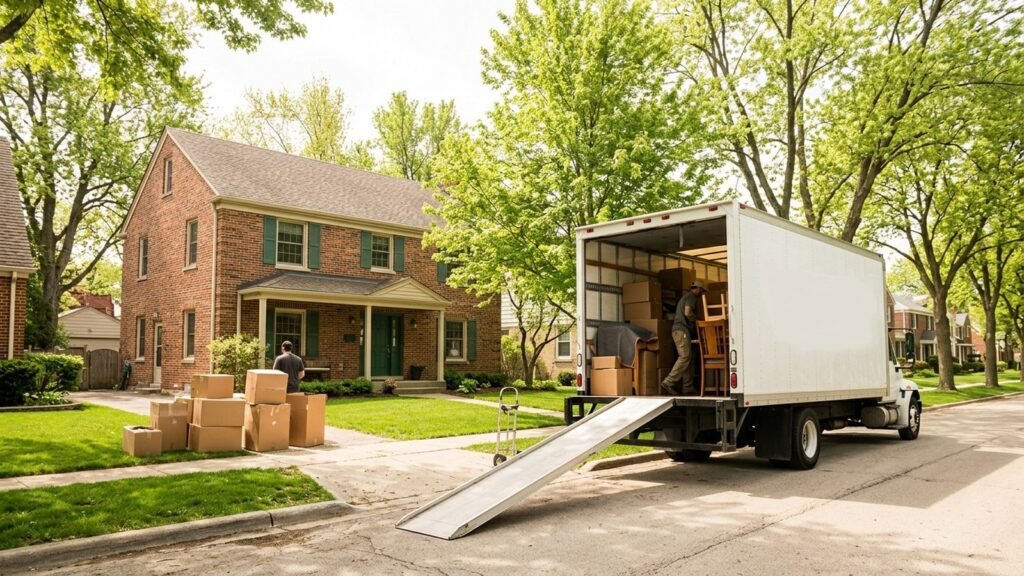
That $145 Moving Stat Is a Trap: What a Chicagoland Move Really Costs
A story went around this month claiming the median local move in America costs $145. If you are sitting in a four-bedroom in Bartlett looking at a basement full of Rubbermaid totes, a treadmill nobody has touched since 2019, and a piano somebody’s grandmother left you, that number is going to feel like a practical joke.
It isn’t a lie, exactly. That figure comes from Lugg, an on-demand app built for hauling a couch across town in a pickup. It measures spur-of-the-moment jobs, and it clusters in August because August is when everybody in the country decides to move at once. It is not a household move. Confusing the two is how people end up standing in a driveway at 6 p.m. on closing day arguing with a crew about a bill that doubled.
So let’s talk about what a real Chicagoland move actually costs, and — more usefully — what Illinois law lets you demand before you hand anyone a deposit.
The actual numbers
Long-distance is the easiest to pin down, because the industry publishes it. Boston to Chicago, for example, currently runs somewhere between roughly $3,300 and $9,500 depending on how much you own, whether you pack yourself, and when you go. That spread is not vagueness — it is the entire negotiation. The low end is a studio’s worth of boxes in October. The high end is a full house, full-service packing, last Friday in July.
Local suburban moves are priced differently: hourly, per crew member, plus a truck fee, and — this is the part that surprises people — the clock usually includes travel time from the mover’s yard to your door and back. A Carol Stream to Bloomingdale move is about four miles. If the company’s yard sits on the other side of the county, you are paying for a lot of expressway that has nothing to do with your furniture. Ask where the truck starts its day. It’s a fair question, and a good mover will answer it without flinching.
The lever nobody uses: when you move
Moving demand collapses from October through April, and rates fall with it — commonly 10% to 20% off peak summer pricing, with midweek and mid-month dates cheapest of all.
Here is where it gets specific to us. Real estate closings in Illinois pile up at the end of the month, because that is how mortgage interest math and lease cycles work. Which means the last few business days of any month are simultaneously the busiest stretch for title companies and the busiest stretch for movers. If your contract has any flexibility at all, closing on the 12th instead of the 29th can save real money on the truck — and it is a far easier ask of a seller than a price reduction.
One more scheduling note that costs local buyers every single year: in Illinois you typically do not get keys until the deal actually funds, and funding does not always happen the instant everyone signs. Do not book a 9 a.m. crew for closing day. Book the afternoon, book the next morning, or negotiate a possession date that is deliberately separate from the closing date. A crew sitting in your new driveway waiting on a wire transfer is a crew you are paying by the hour.
What Illinois actually requires of your mover
This is the part worth taping to the fridge.
If your move stays inside Illinois — Streamwood to Elgin, Hanover Park to Schaumburg — the company must hold a household goods license from the Illinois Commerce Commission. No license, no legal authority to move your things. Licensed intrastate movers are required to:
- File a tariff with the ICC listing their rates and services. This is the big one. An intrastate Illinois mover cannot legally freelance a “special discount” off their filed rates. If someone is offering you a deal that undercuts their own published tariff, you have just learned something about how they run the rest of the business.
- Display their ICC authority number on their trucks and in their advertising. Look for it on the website before you even call. If it isn’t there, that’s your answer.
- Carry liability and cargo insurance, and keep records of every move for at least three years.
Cross a state line and it’s a different rulebook: the mover needs a USDOT number and falls under federal FMCSA jurisdiction. They are required to give you a booklet called Your Rights and Responsibilities When You Move. The single most valuable rule inside it is the 110% rule — on a non-binding estimate, a mover cannot require more than 110% of that estimate before unloading your shipment. Anything above it has to be billed to you at least 30 days later. Hold-your-stuff-hostage pricing is not legal, and saying the number out loud tends to end that conversation quickly.
The quiet costs
Two more that catch suburban buyers off guard. First, if you’re moving into a townhome or condo association — and a good share of the attached inventory in Schaumburg, Carol Stream and Bloomingdale is exactly that — the association may require a certificate of insurance from your mover, a reserved elevator or loading window, and sometimes a refundable move-in deposit. Get that paperwork request to the moving company a week out, not the night before.
Second: the federal moving expense deduction is off the table for nearly everyone. It was suspended for most taxpayers beginning in 2018, and subsequent federal tax legislation has kept it that way outside of active-duty military moves. Budget your move as a real cost rather than a write-off, and confirm your own situation with your tax preparer.
The short version
Get three written estimates. Verify the ICC license for an in-state move and the USDOT number for an out-of-state one. Ask where the truck starts its day. Move mid-month if the contract lets you. And don’t let a $145 headline set your expectations for a house in Bartlett.
If you’re mapping out a move around here and want help thinking through the timing — closing dates, possession, which weeks are quietly cheaper — that’s a conversation we have most weeks, and we’re happy to have it with no pressure attached.
Straight outta the brain of Bob, Garry Real Estate’s in-house lead AI. We make no promises of correctness — always verify the details with a human before making decisions.

