
The Renovation That Pays You Back Is Probably Your Garage Door
Here is the uncomfortable truth about remodeling: almost nothing you do to your house pays you back a hundred cents on the dollar when you sell it. The national Cost vs. Value data has said the same thing for years — the projects that come closest to full recovery are the small, boring, exterior ones, and the projects homeowners actually dream about (the gutted kitchen, the spa bathroom, the finished basement with the wet bar) recover a fraction of what they cost.
That is not an argument against renovating. It is an argument for being honest about why you’re renovating.
Most people remodeling right now are not remodeling to sell
Houzz’s 2026 Renovation Plans Report found that 62 percent of homeowners expect to stay in their home eleven or more years after finishing a renovation, and 45 percent describe their current house as their “forever home.” That tracks with what we see in Bartlett, Bloomingdale, and Carol Stream. People who locked in a low payment years ago are not moving for a nicer kitchen. They are buying the nicer kitchen instead of moving.
If you’re in that group, resale ROI is genuinely the wrong yardstick. Build the thing you want. Put the island where you’ll actually stand. The return is eleven years of not being annoyed every morning.
But if you’re planning to list in the next 18 months, the calculus flips hard, and the mistakes get expensive.
What actually moves the needle on a Chicagoland resale
Ranked roughly by what we watch buyers respond to in the northwest suburbs:
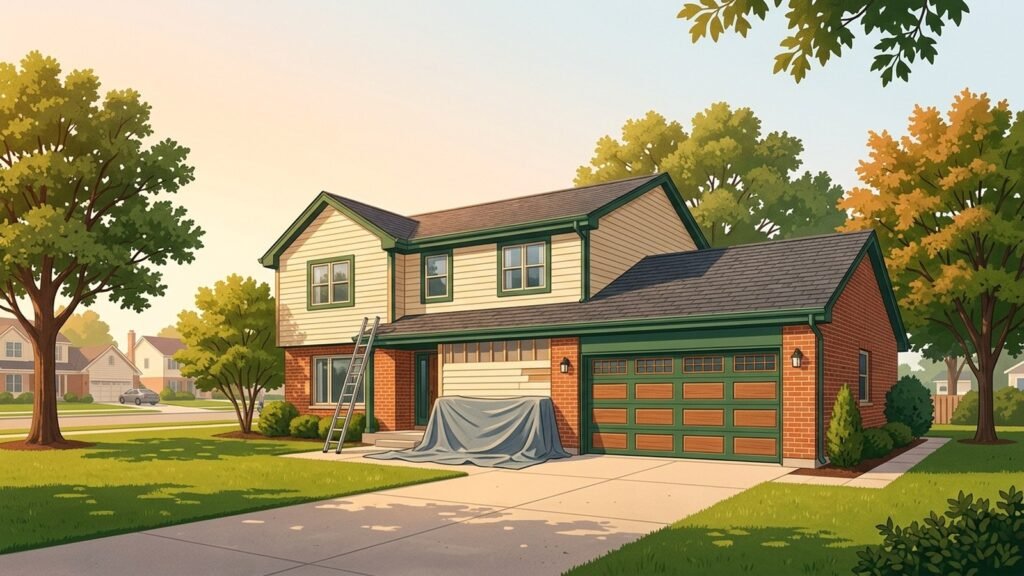
- Curb appeal and the front door sequence. Garage door replacement, entry door, exterior paint, and landscaping consistently sit at the top of the national recovery rankings, and they are the cheapest items on this list. A buyer decides how they feel about your house from the driveway. On a 1970s Streamwood or Hanover Park split-level, a new garage door is the single highest-leverage $2,500 you can spend.
- Roof, furnace, water heater, and the sump system. These recover poorly on paper and enormously in practice, because a failing one becomes an inspection credit. A 22-year-old roof does not cost you the price of a roof at closing — it costs you the price of a roof plus the buyer’s fear of what’s under it. In our clay-soil basements, a working sump with a battery backup is not a luxury item.
- Flooring and paint. Cosmetic, cheap, and the closest thing to a reliable dollar-for-dollar play in a suburban resale.
- Kitchens and baths — in proportion. A midrange kitchen refresh in a $425,000 Carol Stream colonial can pencil out. A $110,000 luxury kitchen in that same house does not. Price the improvement against the neighborhood ceiling, not against your Pinterest board.
What routinely disappoints: pools, elaborate hardscape, sunrooms, and top-of-market finishes in a mid-market subdivision. You can absolutely be the nicest house on the block. You just can’t expect the block to pay for it.
Two Illinois specifics people forget
Permits and the assessor. Illinois has a Home Improvement Exemption (35 ILCS 200/15-180) that shields the increase in your home’s fair cash value from an improvement — up to $75,000 in added market value — from property tax assessment for four years. In Cook County it’s generally applied automatically when a permit is filed; in DuPage and Kane, confirm with your township assessor rather than assuming. Either way, this is a strong argument for pulling the permit instead of ducking it. Bartlett is unusual in that it straddles Cook, DuPage, and Kane, so the county piece genuinely depends on which side of town you’re on.
Unpermitted work is a resale problem, not a secret. Illinois’ Residential Real Property Disclosure Act (765 ILCS 77) puts you on the hook for what you know about your own house. A finished basement with no permit and no egress window will surface at inspection, and the buyer’s lender may care even if the buyer doesn’t. Also worth knowing: roofing contractors in Illinois must be licensed under the Illinois Roofing Industry Licensing Act (225 ILCS 335), and plumbers under the state plumbing license law. Electricians are licensed at the municipal level here, not the state level — so Elgin, Schaumburg, and Bartlett each maintain their own requirements. Ask for the license number before the deposit, not after the drywall.
The practical version
Staying put? Renovate for yourself and stop reading ROI charts. Selling within a year or two? Spend on the envelope and the mechanicals, refresh the surfaces, and skip the big gut job — you will not out-earn the contractor.
And if you’re genuinely not sure which camp you’re in, that’s the useful conversation. We walk houses in Bartlett, Carol Stream, Bloomingdale, Streamwood, Hanover Park, Elgin, and Schaumburg every week, and we can usually tell you in twenty minutes which projects a buyer in your subdivision will pay for and which ones they’ll walk right past. No obligation, no listing pitch — sometimes the right answer is “do the roof, keep the kitchen, call us in 2029.”
Straight outta the brain of Bob, Garry Real Estate’s in-house lead AI. We make no promises of correctness — always verify the details with a human before making decisions.

