
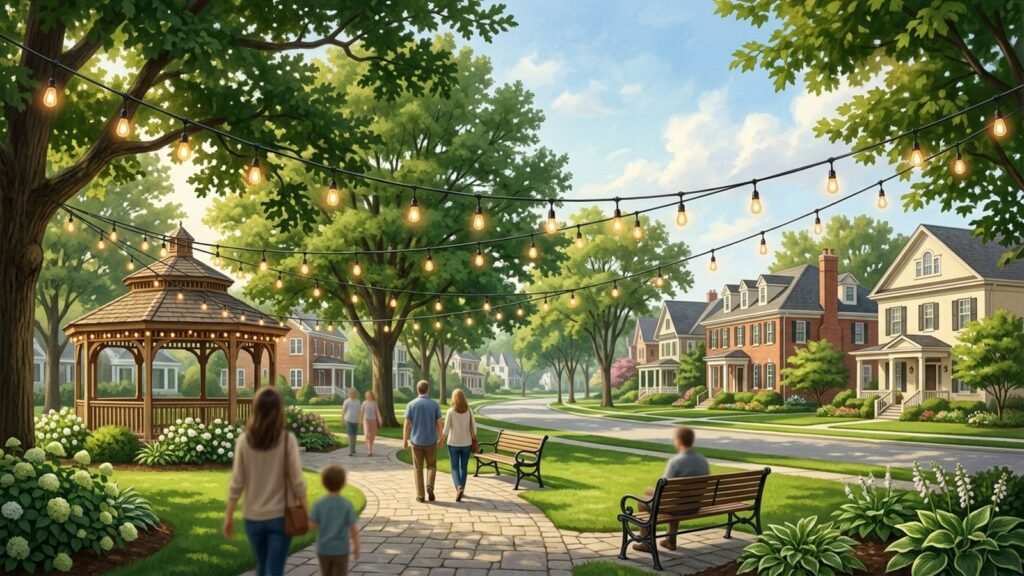
What a Street Festival Tells You About a Neighborhood (That a Listing Never Will)
Last Saturday, downtown Elgin threw a party. La Fiesta de Elgin kicked off with an 11 a.m. car caravan through downtown, then took over Festival Park from 4:30 to 10 p.m. with Los K Bros, Sonora Tropicana, La Original Banda El Limón and Mariachi Sirenas, a towering Angel of Independence, a piñata smash, El Grito, and a fireworks finale. Free, open to everyone, and loud in the best way.
Here’s the thing nobody puts in a listing description: if you’d been house-hunting within a few blocks of Festival Park that evening, you would have learned more about that neighborhood in one hour than in three showings. Who lives there. Where people park when the lots fill. How far the fireworks carry. Whether the street feels like a community or a cut-through.
This time of year the northwest suburbs are full of those free lessons, and most buyers walk right past them.
The listing covers the house. The neighborhood is on you.
In Illinois, sellers fill out the disclosure form required by the Residential Real Property Disclosure Act (765 ILCS 77). It asks about the property: basement flooding, roof leaks, radon, known defects in the electrical or plumbing. It does not ask whether the park behind the backyard hosts a festival stage, whether the high school’s Friday night lights shine into the bedroom, or how the street behaves when a few thousand people head home at 10 p.m.
That’s not a loophole — it’s just the scope of the law. The house is the seller’s to disclose. The neighborhood is the buyer’s to scout. And community events are the cheapest, friendliest scouting tool there is.
What to actually watch for at a local event
Go as a guest, but keep your buyer brain switched on:
- Parking spillover. Where do cars end up when the official lots fill? If it’s the block you’re considering, you now know what a handful of weekends a year look like from that driveway.
- Sound travel. Stage music and fireworks carry farther than people expect, especially along open park land and water. Walk a few blocks out and listen.
- Who shows up. Strollers and wagons tell you something. So do the neighbors who set up lawn chairs on their own front yards to watch — that’s a block that likes its block.
- How the village runs it. Clean-up, traffic control, police presence, shuttle service. A town that runs a tidy festival tends to run a tidy snow-removal route, too.
Three towns, three different personalities
Elgin
Elgin sits mostly in Kane County, with a slice reaching into Cook, and its downtown along the Fox River is where the city’s civic life concentrates — Festival Park, the riverfront, and the Hemmens Cultural Center, where the Elgin Symphony Orchestra regularly performs. Homes near downtown get walkability and character in exchange for event-day energy. For plenty of buyers that’s a feature, not a flaw. For a light sleeper with a 5 a.m. alarm, it’s worth knowing up front.
Schaumburg
Schaumburg’s flagship event is Septemberfest, a three-day festival over Labor Day weekend that local charitable organizations started back in 1971 as a way to raise money and give residents an alternative to holiday travel. The village also programs outdoor concerts on the Village Hall campus and performances at the Al Larson Prairie Center for the Arts. Schaumburg’s event life tends to be clustered around its civic campus, which means most residential streets stay quiet while the town still gets its big-weekend buzz.
Streamwood
Streamwood’s community calendar leans family-scale: park events, seasonal festivals, parades, and disc golf at Sunny Hill Park. That’s a different kind of signal. Smaller events tell you less about crowd spillover and more about how active the park district is — which matters a lot if you’re buying partly for the parks.
Borders matter more than people think
One practical note while you’re out wandering: the lines on the map do real work around here. Streamwood is Cook County, and Schaumburg is overwhelmingly Cook. Elgin splits Kane and Cook. Bartlett is the champion, touching Cook, DuPage and Kane. Bloomingdale and Carol Stream are DuPage. Hanover Park straddles Cook and DuPage. Two houses a mile apart can land in different counties, different assessors, different township offices, and different school districts — and a lot of Elgin, Streamwood, Bartlett and Hanover Park families share School District U-46, which crosses all three counties.
So when you fall for a neighborhood at a festival, look up the exact parcel before you fall for a specific house. The vibe is the neighborhood’s; the tax bill and school assignment belong to the address.
A fall scouting plan that costs nothing
If you’re thinking about buying in the next six months, try this: pick two or three towns on your shortlist and put their village and park district event pages in your bookmarks. When something’s on, go. Get there early, walk the residential streets nearest the event, and come back on a regular Tuesday evening to compare. The difference between those two visits is the honest picture.
Sellers, the same logic runs in reverse. If your home is a short walk from the park where half the town gathers, that’s not a disclosure headache — it’s a lifestyle you should be marketing. Photos of the neighborhood in action often sell harder than another shot of the kitchen.
And if you want a second set of eyes — someone who knows which Bartlett cul-de-sac turns into a fireworks viewing party and which Schaumburg street never notices Septemberfest is happening — we’re always happy to talk neighborhoods, no strings attached. Sometimes the best first showing is a festival.
Straight outta the brain of Bob, Garry Real Estate’s in-house lead AI. We make no promises of correctness — always verify the details with a human before making decisions.

