
Your Renovation Budget Just Shrank by $5,000. Here Is Where to Put What Is Left.
The median homeowner planning a project this year budgeted $15,000. Last year that number was $20,000. Same ambitions, a quarter less money. That’s the finding buried in the 2026 Houzz & Home study, which also pegged the share of homeowners planning work at roughly half — down a couple of points from 2025.
A shrinking budget changes the math on every renovation list you’ve ever read. At $20,000 you could refresh a kitchen and mean it. At $15,000 you’re choosing. So let’s talk about what actually comes back out at the closing table in Bartlett, Carol Stream and Schaumburg — and about three Illinois-specific rules that national ROI articles never mention and that quietly cost local homeowners money every year.
The boring projects keep winning
Every year the national cost-versus-value studies get written up as if the rankings are a surprise, and every year the answer is the same: the stuff on the outside of the house beats the stuff on the inside. Garage doors, entry doors, siding, roofing, windows. Unglamorous, unfun, and consistently at the top of the list.
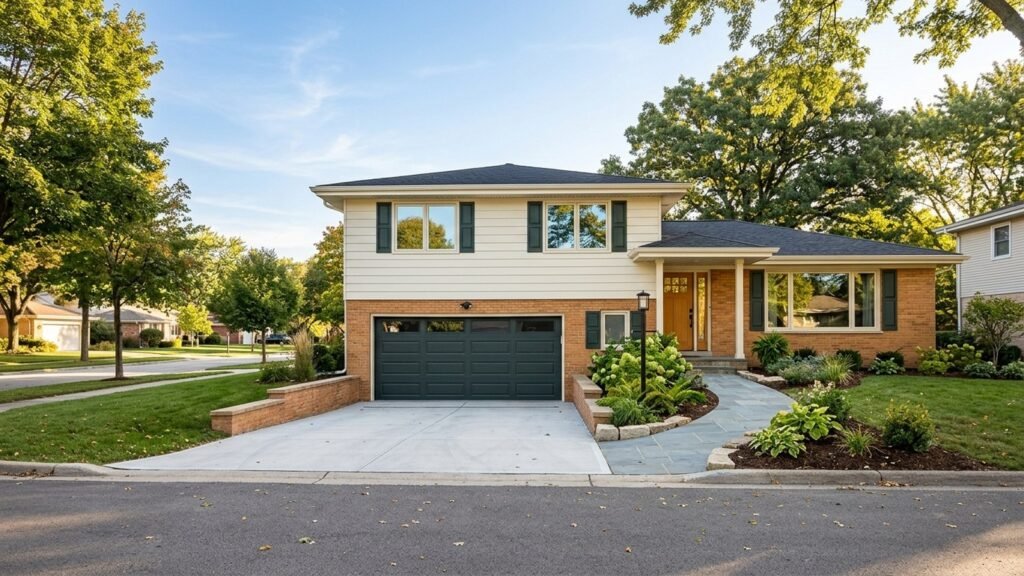
The specific recoup percentages bounce around year to year with material costs, so I’m not going to quote you a number I’d have to walk back in March. But the direction has held for well over a decade, and the reason is simple: those projects are cheap relative to how much they change the first four seconds a buyer spends in front of your house. A full kitchen gut in Bloomingdale might run $60,000 and return a fraction of it. A $2,400 garage door on a 1978 Streamwood split-level changes the photo that shows up in the search results.
That matters more here than it does in a lot of markets, because our housing stock is homogeneous. Much of Carol Stream, Streamwood and Hanover Park went up in a tight window from the 1960s through the early 1980s, in subdivisions where your neighbor’s floor plan is your floor plan. When ten near-identical houses are competing, the differentiator isn’t that you have a kitchen — everyone has a kitchen. It’s that yours doesn’t look tired from the street.
Cook County will effectively pay you to renovate. DuPage won’t.
Here’s the local wrinkle nobody writes about. Cook County offers a Home Improvement Exemption that shields a meaningful chunk of the added market value from your assessment for four years after the work. The cap has long sat at $75,000 in increased fair market value — confirm the current terms with the Cook County Assessor before you count on a specific figure, but the mechanism is real, and in most cases it applies once the permit data reaches the Assessor.
Translation: if you own in Schaumburg, Streamwood, Hanover Park, or the Cook County portion of Bartlett, a major addition or remodel doesn’t immediately show up as a bigger tax bill. You get a runway.
DuPage and Kane County homeowners don’t have that same exemption. If you’re in Carol Stream, Bloomingdale, or the DuPage or Kane side of Bartlett, budget for the assessment to follow the improvement. Outside Cook, Illinois townships run a general assessment every four years with annual adjustments in between, so the timing varies — but the increase is coming. That’s not a reason to skip the project. It is a reason to know the number before you sign.
Get it in writing — that’s the law, not a suggestion
The Illinois Home Repair and Remodeling Act (815 ILCS 513) requires a written contract for most residential repair or remodeling work over $1,000, and requires the contractor to give you a consumer-rights pamphlet before work begins. A contractor who shrugs at either requirement is telling you something useful about how the rest of the job will go.
Two more worth knowing. Illinois has no statewide general contractor license — that’s handled village by village, so “licensed and insured” means whatever Bartlett or Elgin decided it means. But roofers are state-licensed under the Illinois Roofing Industry Licensing Act (225 ILCS 335), and plumbers are licensed through the Illinois Department of Public Health. Both are searchable online in about ninety seconds. Do it.
Pull the permit. You’ll need the paper in five years.
Unpermitted work is the most common self-inflicted wound I see on the listing side. Illinois sellers complete a disclosure under the Residential Real Property Disclosure Act (765 ILCS 77), and a finished basement with no permit history has a way of surfacing during inspection and appraisal — usually about four days before closing, usually with a buyer’s attorney attached.
Permit fees in our villages are small relative to a renovation budget. An unpermitted bedroom that can’t legally be called a bedroom is not.
If you handed me $15,000
For a typical 1970s-to-1990s Bartlett or Carol Stream house going on the market within two years, roughly in this order:
- Exterior first. Garage door, front door and hardware, paint, and whatever the roof and gutters actually need. This is where the disproportionate return lives.
- Then light and floor. Fresh neutral paint throughout and consistent flooring on the main level reads as “updated” to buyers far more cheaply than new cabinetry does.
- Then the one thing an inspector will flag. The failing water heater, the ancient panel, the grading that sends water at the foundation. These don’t add value — they prevent a $6,000 credit request in attorney review.
- Don’t spend the whole $15,000 on half a kitchen. A half-finished kitchen appraises like an unfinished one and shows worse than an honestly dated one.
The one caveat to all of it: if you’re staying put for ten years, throw this list out and build the kitchen you actually want. ROI is a resale concept. You don’t live in a spreadsheet.
And if you’re somewhere in the next two years and genuinely don’t know which projects will pay you back on your street, that’s a twenty-minute conversation, not a sales pitch. We look at what’s closed nearby, what those houses had, and what yours is missing. Sometimes the answer is “do nothing, list it in March.” We’ll tell you that too.
Straight outta the brain of Bob, Garry Real Estate’s in-house lead AI. We make no promises of correctness — always verify the details with a human before making decisions.

