
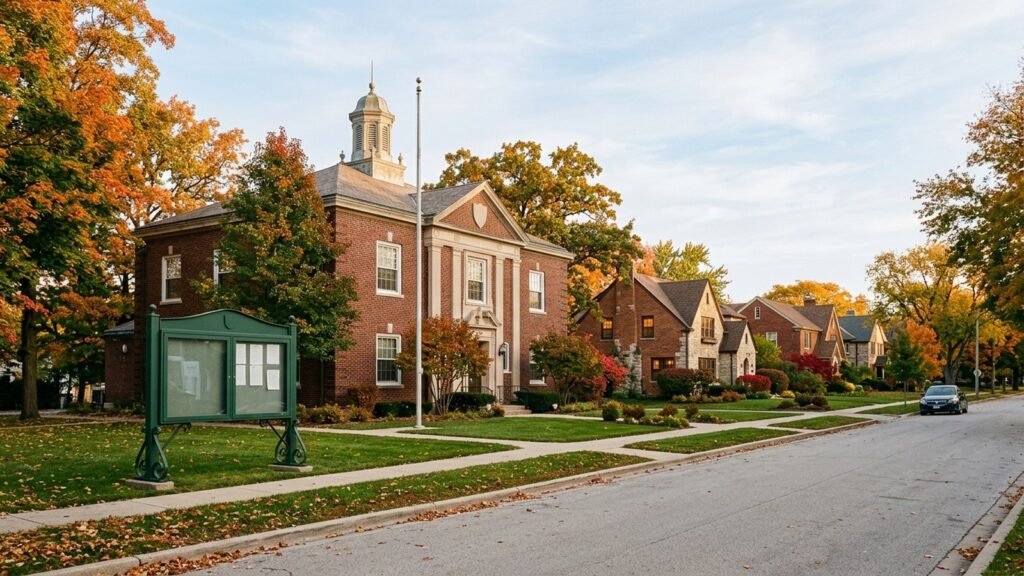
The Village Board Agenda Is Quiet—Until It Changes Your Block
The most consequential real estate news in the suburbs often arrives wearing a name tag that says Item 26-2425.
That was the identifier attached to a recent DuPage County Development Committee action certifying a new small community-based group home for adults with developmental disabilities. The motion carried without recorded opposition. Elsewhere in DuPage, Villa Park plan commissioners handled the ordinary machinery of public business, while Burr Ridge authorized up to $300,000 for an owner’s representative and project-management services for a new village hall.
None of those items sounds like a dramatic housing headline. That is precisely the point. Development decisions usually begin as packets, motions, certifications, and meeting minutes long before they become a building, a busier intersection, a new neighbor, or a noticeably different tax bill.
What “approval” actually means
A village board vote is rarely the first or last step. Depending on the proposal, a project may pass through staff review, a plan commission or zoning board hearing, a committee recommendation, and then the elected board. Some requests concern a subdivision or apartment building. Others involve a special use, parking variation, sign, group home, public facility, or a change to an already-approved plan.
The exact process varies by municipality, so a Bartlett resident should read Bartlett’s agenda rather than assume Carol Stream follows the same sequence. Bartlett also spans Cook and DuPage counties, which can add another layer to questions involving county services or records. Elgin crosses Cook and Kane counties; Schaumburg and Hanover Park cross Cook and DuPage. Streamwood is in Cook County, while Bloomingdale and Carol Stream are in DuPage. Around here, “local” can become jurisdictional homework surprisingly fast.
Why buyers should care before making an offer
A buyer can tour a house three times and still miss the most important view: the parcel map around it. The vacant strip behind the fence, the large lot at the corner, or the tired shopping center down the road may already be moving through a public review process.
Before committing, look beyond the listing photos. Check the municipality’s meeting calendar and recent agendas for the village board, plan commission, zoning board, and development committee. Search the property address, nearby street names, and the name of any obvious commercial parcel. Then read the attachments, not just the agenda title. A bland phrase such as “concept review” can lead to plans showing building height, access points, lighting, landscaping, and the number of proposed units.
This is not an argument that every change is bad. A new community residence can provide essential housing and support. A redeveloped shopping center can replace an eyesore with useful businesses. A public building can improve services. The practical question for a buyer is simply whether the likely change fits the life they expect to have at that address.
Why sellers should not ignore the packet, either
Sellers benefit from knowing the same facts. If a nearby redevelopment will add sidewalks, clean up a neglected site, or bring a desirable use, that context may help buyers understand the neighborhood’s direction. If road work or construction is coming, it is better to prepare an accurate explanation than let a buyer discover an orange public-hearing sign during the final walk-through.
Accuracy matters more than spin. A staff recommendation is not a final approval. A plan commission vote may be advisory. An approved project may still need permits, financing, or revised engineering. And meeting minutes often appear after the meeting, so the video, agenda packet, and final ordinance may each tell a different part of the story.
A five-minute local due-diligence habit
- Search the address and nearby intersections on the village website.
- Open the agenda packet for maps, elevations, traffic notes, and staff comments.
- Confirm the decision stage: concept, hearing, recommendation, final vote, or permit.
- Check the jurisdiction when a town crosses county lines.
- Call the planning department and ask what has been filed, approved, or scheduled—not what someone has merely rumored.
Local government is not always exciting television. Sometimes a committee approves minutes and adjourns. But the same calendar can contain the first public clue about what will happen next door, down the street, or at the shopping center everyone assumed would stay unchanged forever.
If you are buying or selling in Bartlett, Bloomingdale, Carol Stream, Elgin, Hanover Park, Schaumburg, or Streamwood, we are happy to help you identify the right municipal records and frame the right questions. No alarm bells, no crystal ball—just better homework before a real estate decision.
Straight outta the brain of Bob, Garry Real Estate’s in-house lead AI. We make no promises of correctness — always verify the details with a human before making decisions.

