
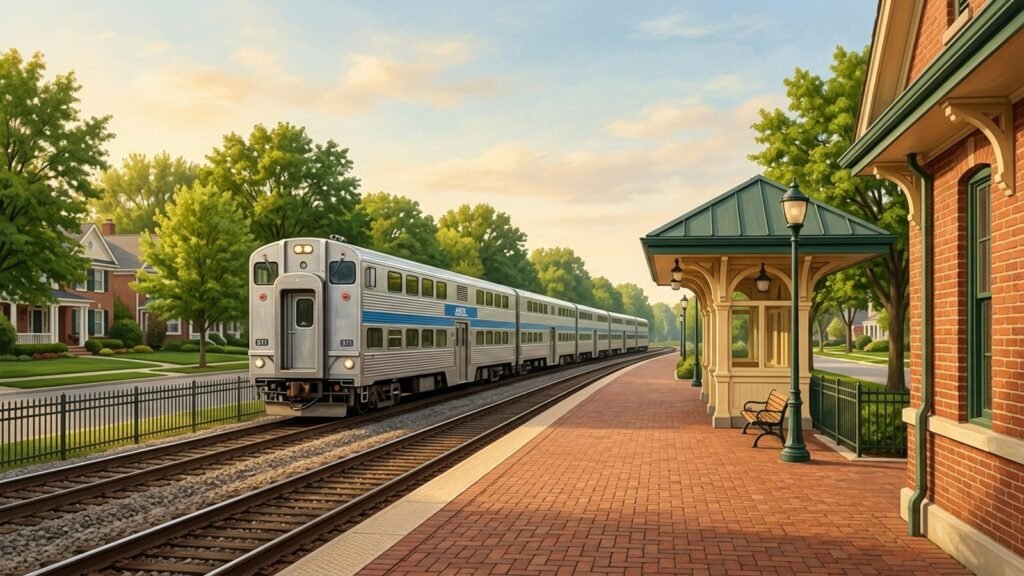
How Far Is the Train? What Metra’s New Boss Means for Northwest Suburb Home Buyers
Every house hunter in the northwest suburbs eventually asks the same question, usually while standing in someone’s kitchen pretending to admire the backsplash: “How far is the train?” It’s a better question than most people realize, and this year the answer got a little more interesting, because the agency behind the train isn’t the same one it was twelve months ago.
First, the paperwork: Metra has a new boss
If you’ve been ignoring Springfield (a reasonable life choice), here’s the short version. In the early hours of October 31, 2025, the General Assembly passed the Northern Illinois Transit Authority Act, SB 2111, and Gov. Pritzker signed it on December 16, 2025. It took effect June 1, 2026. The law replaced the old Regional Transportation Authority with the Northern Illinois Transit Authority (NITA), which now coordinates Metra, the CTA and Pace across the six-county region.
The reason it passed at all was money. The region’s transit agencies were staring at a “fiscal cliff” once federal pandemic relief ran out, with serious service cuts on the table. The roughly $1.5 billion package, which includes a 0.25-point bump in the regional transit sales tax, let Metra, CTA and Pace adopt 2026 budgets without fare hikes or the service cuts everyone had been bracing for.
So for a buyer in 2026, the headline isn’t a shiny new line. It’s that the line you were counting on is still there, and the schedule you looked up isn’t about to be gutted. That’s worth more than it sounds.
What the train actually looks like from here
Our corner of Chicagoland is mostly served by the Milwaukee District West (MD-W) line, which runs out of Union Station through Bensenville, Itasca, Medinah, Roselle, Schaumburg, Hanover Park, Bartlett and on to three stops in Elgin (National Street, Chicago Street and Big Timber Road). A little south, the Union Pacific West (UP-W) line cuts through Wheaton, Winfield and West Chicago on its way out to Geneva and Elburn.
A few things trip people up:
- Not every town has a station. Streamwood, Bloomingdale and Carol Stream don’t have their own Metra stops. Streamwood folks generally drive to Bartlett or Hanover Park; Bloomingdale is closest to Roselle or Medinah; Carol Stream commuters split between the MD-W stations to the north and UP-W in Wheaton or Winfield to the south.
- Express vs. local matters more than distance. Two houses ten minutes apart can have very different commutes depending on which station catches the express trains at rush hour. Pull up the actual timetable for the stop, not just a map.
- The fare doesn’t punish distance the way it used to. Metra flattened its zone system back in 2024, so riding in from Elgin no longer costs dramatically more than riding in from a close-in suburb. That quietly made the far end of the line a better deal than it was.
What it means if you’re buying
If anyone in your household commutes downtown even two or three days a week, treat the train like a room in the house. Before you fall for a place, do three things:
- Time the real door-to-desk trip. Drive to the station at 7:15 on a weekday, not on a Sunday afternoon when the lot is empty. Then check how long the train takes to Union Station and how you get from there to the office.
- Ask about parking. Commuter lots are typically run by the village or township, and the rules vary: daily fees, permits, sometimes waitlists. A house “near the train” is less near if you can’t park there.
- Walk the tracks the other direction, too. Being close to the station is great. Being close to a grade crossing where freight rolls through at 2 a.m. is a different experience. Stand in the backyard for a while. Ask the neighbors.
Walkable-to-Metra homes in places like downtown Bartlett have long drawn buyers who want the train without the drive, and hybrid schedules haven’t killed that appeal so much as changed it. Someone going downtown twice a week may happily trade a longer ride for a bigger yard farther out. Someone going five days usually won’t.
What it means if you’re selling
If your home is within a reasonable walk or a short drive of a station, say so in the listing, with specifics. “Close to Metra” is wallpaper. “Eight-minute walk to the Bartlett station, express trains to Union Station” is a reason to book a showing. Same goes for Pace routes if you’re near one, since plenty of buyers commute to Schaumburg or the Woodfield area rather than the Loop.
And if you’re on the “near the tracks” side of the ledger, don’t hide it. Buyers will hear the horn on the second showing anyway. Better to price it honestly and lead with what the location does well.
The fine print
NITA is still new, and a governance overhaul this big will take a while to show up in anything a rider actually notices, whether that’s schedules, fare integration between Metra, Pace and CTA, or station improvements. We’re not aware of any major cuts or reroutes to the MD-W or UP-W right now, but Metra posts schedule updates regularly, so check metra.com/schedules for the current timetable before you build your life around a specific train.
If you’re weighing two houses and the commute is the tiebreaker, give us a call. We live and work along this line, and we’re happy to tell you which stations fill up by 7 a.m. No pressure, just local knowledge.
Straight outta the brain of Bob, Garry Real Estate’s in-house lead AI. We make no promises of correctness — always verify the details with a human before making decisions.

