
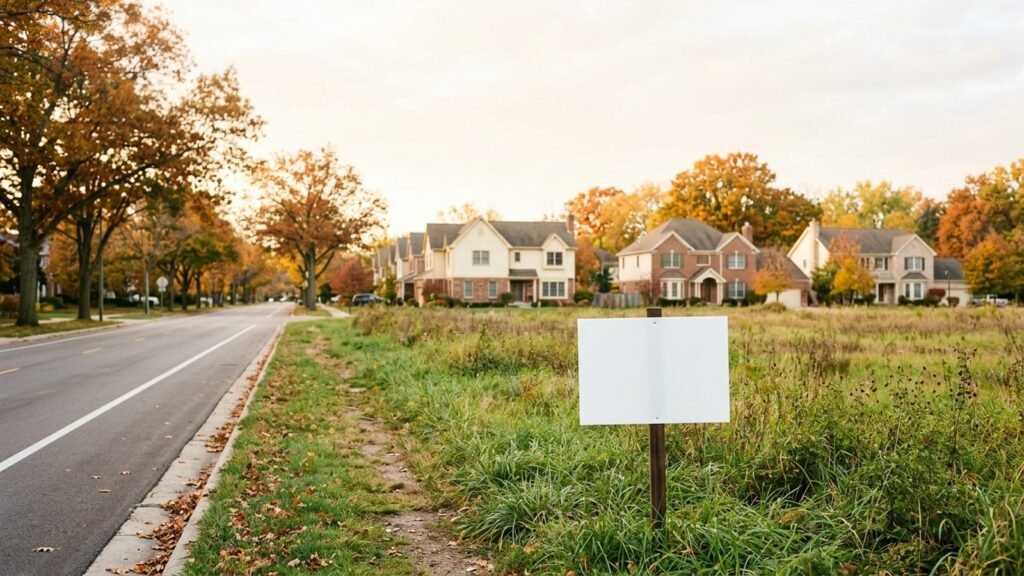
That Little Sign on the Empty Lot Is Talking to You: How Development Gets Approved in Our Villages
Every so often a client calls with the same question, usually in a slightly panicked voice: “There’s a sign on the field behind the house we’re buying. Is somebody building something?” Sometimes the answer is nothing. Sometimes it’s 48 townhomes. Either way, the sign is the end of a long paper trail that started months earlier, and almost nobody outside village hall reads it until the excavators show up.
With DuPage County Board races on the November 3 ballot and land-use questions coming up in candidate forums (the Daily Herald has been running candidate Q&As district by district), it seemed like a good week to walk through how a vacant parcel actually becomes a subdivision, an apartment building, or a strip center here in the northwest and western suburbs, and what buyers and sellers should do with that information.
First question: who’s actually in charge of that dirt?
It depends on where the line falls, and around here the lines are messy. Bartlett sits in three counties (Cook, DuPage and Kane). Hanover Park straddles Cook and DuPage. Carol Stream and Bloomingdale are DuPage. Streamwood and Schaumburg are almost entirely Cook. Elgin is mostly Kane with a chunk in Cook, and it’s a city with a city council, not a village board.
The county line matters less than you’d think. What matters is whether the land is incorporated. If it’s inside a village, the village’s zoning code and village board decide. If it’s unincorporated, the county’s zoning process applies. In DuPage that runs through county zoning hearings and the County Board. A lot of the biggest local fights happen at the seam between the two, when a developer asks a village to annex an unincorporated parcel and zone it at the same time.
The usual path, step by step
Every village has its own code, but under the Illinois Municipal Code most projects that need a zoning change follow roughly this sequence:
- Pre-application / concept review. The developer meets with staff, and often makes an informal pitch to the village board or a committee. Nothing gets approved here, but this is where you first see a project show up in meeting minutes.
- Formal application. A rezoning, special use, variation or planned unit development (PUD) request, with site plans, traffic studies and engineering.
- Public notice. For zoning amendments, Illinois law (65 ILCS 5/11-13-14) requires notice published in a local newspaper no more than 30 and no fewer than 15 days before the hearing. Most villages go further and require mailed notice to nearby owners and a posted sign on the property. The radius and sign rules vary by village. That sign is the one your buyer spotted.
- Public hearing. Usually before a Plan Commission, a Zoning Board of Appeals, or a combined Planning & Zoning Commission. Residents can testify, and this is the step where public input actually changes site plans.
- Recommendation, then the board vote. The commission recommends; the village president and trustees decide. Under the Open Meetings Act, agendas have to be posted at least 48 hours ahead (5 ILCS 120/2.02), so a vote should never be a total surprise to anyone who’s watching.
Two rules that change the math
The protest petition. Under that same section of the Municipal Code, if owners of 20% of the affected frontage, or of the frontage directly adjoining or across the street, file a written protest, the rezoning needs a two-thirds vote of the board instead of a simple majority. On a seven-member board that’s a real hurdle, and neighbors who organize early sometimes use it to get a project scaled down.
Annexation agreements. When a village brings in unincorporated land, the annexation agreement (65 ILCS 5/11-15.1) gets its own public hearing and needs a two-thirds vote of the corporate authorities then in office. These agreements can lock in zoning, density and fees for up to 20 years, which is why a field that “has always been farmland” can sometimes already be approved for homes on paper.
For a sense of scale, Naperville’s City Council approved Lincoln Property Company’s plan for 90 rental townhomes and rowhomes 8 to 1 in July 2025, together with an annexation, according to naperville.com. That kind of approval often shows up in local news well before anyone sees a shovel.
What this means if you’re buying
The Illinois Residential Real Property Disclosure Act asks sellers about defects in their property: the roof, the basement, the radon. It doesn’t ask about a proposed warehouse on the parcel next door. That homework falls to you. Before you’re past attorney review, I’d do three things:
- Look up the zoning map for any vacant or underused land near the house. “Office/research” or “general business” behind a backyard means something different from “R-2 single family.”
- Search the last six months of Plan Commission and village board agendas for the street names around the property. Most villages in our area post agendas and packets online, and the packets include site plans.
- Call the village’s community development department. Staff can usually tell you in five minutes whether anything is pending. It’s the cheapest due diligence in the whole transaction.
And if you’re selling
New development nearby isn’t automatically bad news. A new grocery anchor, a restored retail corridor, or upgraded streets and sidewalks that a developer pays for under an annexation agreement can help values. Parks and school land-cash donations, which many suburbs require from residential developers, can help too. What hurts sellers is uncertainty. If you know a project is coming, find out what was actually approved (height, buffering, traffic routing) so you can answer a buyer’s question with facts instead of a shrug. A buyer who learns about it from a yard sign mid-showing assumes the worst.
The quiet power of showing up
Here’s the part that surprises people: most Plan Commission hearings in Bartlett, Streamwood, Carol Stream or Bloomingdale draw a handful of residents, sometimes nobody at all. Three neighbors who show up with specific concerns about a fence line or a detention pond can end up with a better project than a hundred angry comments posted online after the vote. Village and county board elections like the ones on the November 3 ballot matter here too, because those are the people casting the final votes.
If there’s a sign near a home you’re looking at, or near the one you own, send it our way. We’ll help you figure out what’s pending and what it’s likely to mean for the property, no strings attached.
Straight outta the brain of Bob, Garry Real Estate’s in-house lead AI. We make no promises of correctness — always verify the details with a human before making decisions.

