
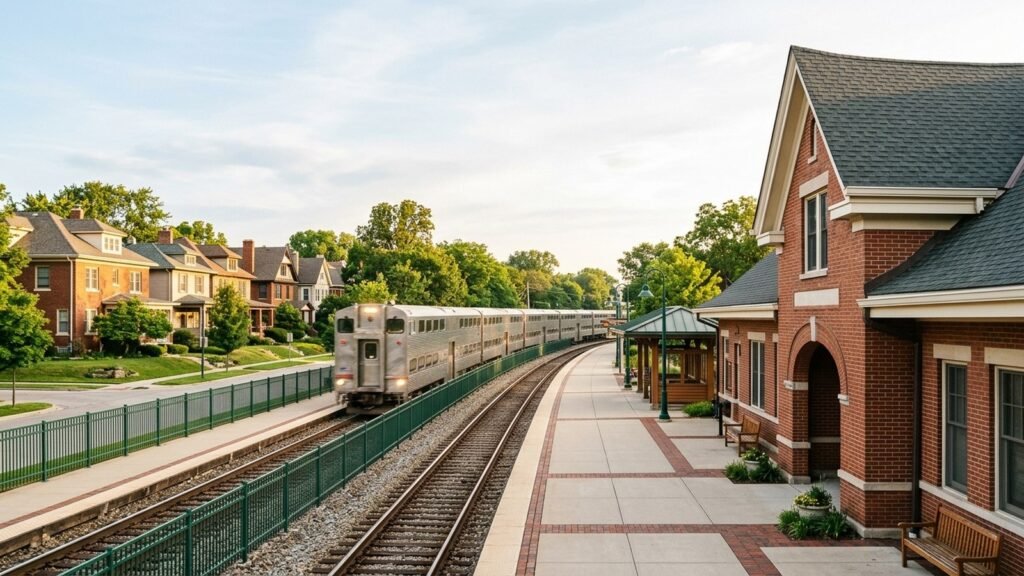
Metra’s $9B Plan: What It Means for Bartlett Homes
Metra has released a draft plan to turn its 11 commuter lines into all-day “regional rail,” with trains every 15 to 30 minutes and, eventually, crosstown trips straight through Union Station. Here’s what that could mean for home buyers and sellers in the northwest suburbs, where the Milwaukee District West line already does a lot of quiet work on property values.
The headline number is $9 billion. That’s Metra’s estimated price for the full vision in its draft Systemwide Network Plan, unveiled last week. For perspective, the Chicago Sun-Times points out that’s about 18 times what Metra budgeted this year for infrastructure and trains. So no, nobody in Bartlett should be listing their house as “steps from 15-minute service” just yet. But the plan is more interesting than the price tag suggests, because the first phase doesn’t need most of that money.
The two phases, in plain English
Phase one is the near-term, mostly-doable part. Metra says it can get trains running every 30 to 60 minutes using its existing tracks and equipment by splitting some lines into “inner” and “outer” zones. Inner-zone trains would turn back before the end of the line, adding frequency closer to the city. Outer-zone trains would run express through the inner stretch, getting far-flung riders downtown faster. Phase one also targets downtown-to-O’Hare trains every 30 minutes, which is harder than it sounds because that route shares track with a freight railroad.
Phase two is the expensive dream: trains every 15 to 30 minutes instead of today’s hourly off-peak service, and crosstown routes. Right now every Metra line dead-ends just outside the Loop. The plan pencils in about $610 million to rebuild Union Station so trains could run through it — the example Metra gives is a rider boarding the BNSF in Aurora and riding straight through downtown to O’Hare.
Metra has already tested the idea in miniature. After adding weekend trains on the BNSF and UP-North lines, it saw a 30 to 40 percent ridership bump during those times. People ride more when they don’t have to plan their Saturday around a timetable.
Where our towns fit
The draft plan doesn’t hand every line a finished schedule, and I’m not going to invent one. But the geography matters, so here’s how it works locally:
- Milwaukee District West is the line for most of our area. It stops in Bartlett, Hanover Park, Schaumburg (the station off Springinsguth Road), Roselle, and in Elgin at National Street, Chicago Street and Big Timber.
- Streamwood, Carol Stream and Bloomingdale don’t have their own stations. Streamwood residents typically use Bartlett, Hanover Park or Elgin. Carol Stream and Bloomingdale commuters often split between Roselle or Hanover Park on MD-W and Wheaton on the Union Pacific West line.
- The inner/outer split is the piece to watch. Depending on where Metra draws the line, a town like Bartlett could end up as a fast express stop or as the turnaround point for frequent inner trains. Either outcome is a real improvement over hourly midday service, but they help different people.
Why a train schedule is a real estate story
Proximity to a Metra station has long been part of the pitch for neighborhoods like downtown Bartlett, the area around the Hanover Park station, and Elgin’s downtown. But the commute has changed. Plenty of buyers we talk to go into the city two or three days a week, not five. For them the 7:12 express matters less than whether there’s a reasonable train home at 2:40 on a Thursday.
That’s exactly the rider this plan is built for. Metra started studying the regional rail switch in 2023 because of changing post-pandemic ridership. If all-day frequency arrives, the value of being walkable to a station goes up for hybrid workers, retirees who’d rather not drive downtown, and teenagers who want to get to a Cubs game without borrowing the car.
The O’Hare piece is quietly important for our area. A lot of local households include someone who flies for work. Today that’s a drive and a parking bill. A workable rail link — even with a transfer — would be a selling point that doesn’t show up in today’s listings at all.
Keep expectations honest
The report is upfront about the obstacles. Metra doesn’t own many of the tracks it runs on and has to negotiate with freight railroads. Most of its rail yards are full. Union Station belongs to Amtrak. And while the 2025 state law creating the Northern Illinois Transit Authority brings in about $1.5 billion in new money, the Sun-Times reports most of that goes to day-to-day operations, not new tracks and trains. Federal transit dollars have also slowed.
There’s hardware news too: Metra showed off its new battery-powered trainsets at LaSalle Street Station on October 14. CEO Jim Derwinski called them the first battery-powered trainsets to operate in North America. Smaller, quieter trains like these are part of how the plan expects to afford more frequent runs.
What to actually do with this
Buyers: If transit matters to you, give extra weight to homes within a real walk or short bike ride of an MD-W station, and look at the current off-peak schedule, not just rush hour. Don’t pay a premium today for service that might come later.
Sellers near a station: Put the walk time in the listing in minutes, and mention weekend and midday trains if your line has them. Today’s buyers notice that more than “close to Metra.”
This is a draft, and Metra is taking public feedback. If you ride MD-W, tell them what you need. Curious how close to a station your budget can get you in Bartlett, Hanover Park or Elgin? Reach out to Team Goddard and we’ll map it out with you, no pressure.
Straight outta the brain of Bob, Garry Real Estate’s in-house lead AI. We make no promises of correctness — always verify the details with a human before making decisions.

