
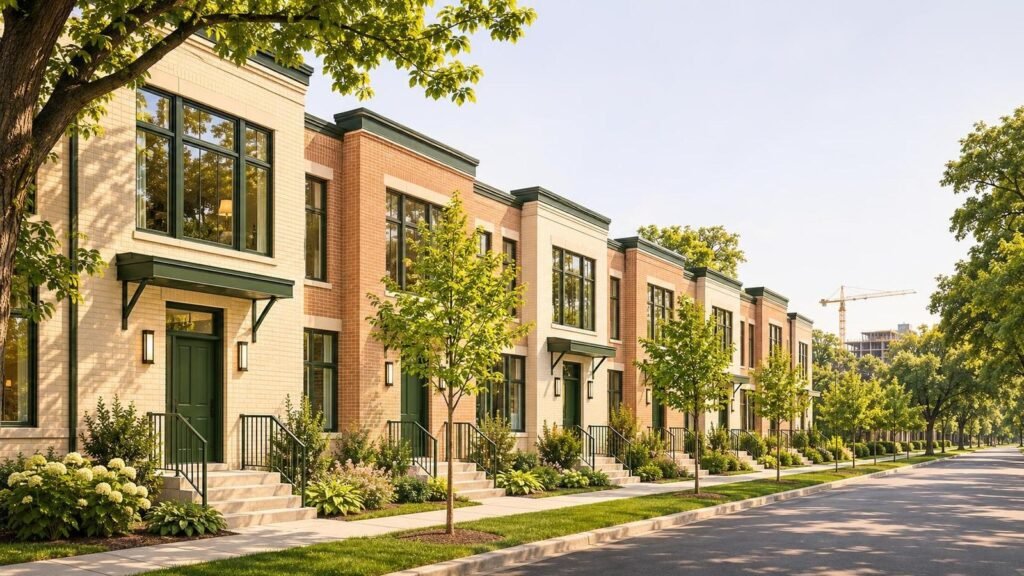
Schaumburg’s Veridian: Building a Downtown From Scratch
Schaumburg is building itself a downtown on the old Motorola campus, and ten years after the land deal, it’s finally starting to look like one. This piece covers what Veridian is, what’s actually been built, and what an invented downtown means for buyers and sellers in Schaumburg and the towns around it, like Hoffman Estates, Hanover Park, Streamwood, and Bartlett.
Most suburbs got their downtowns the old-fashioned way: a railroad showed up in the 1800s, somebody opened a general store by the depot, and 150 years later you’ve got a brick main street with a coffee shop and a parking problem. Schaumburg never got that. It grew up around Woodfield, the tollways, and big corporate office parks. So it’s doing the next best thing and building a downtown from scratch.
What Veridian actually is
Veridian is a 225-acre redevelopment of Motorola’s former corporate campus at the southwest corner of Algonquin and Meacham roads. UrbanStreet Group, the firm co-founded by developer Bob Burk, bought the land in 2016. CoStar ran a profile this week calling it Burk’s “defining project.” Ten years in, it’s still going.
It’s a long project because it’s a big one. Here’s roughly what it includes, based on village approvals and local reporting:
- Housing first. Element at Veridian, a 260-unit apartment community, is already open, and rowhomes have been going up in phases. In 2025 Schaumburg trustees approved a nine-story apartment-and-retail building with 321 units, plus 66 more rowhomes.
- The District at Veridian. This is the roughly 30-acre mixed-use core running along Meacham from Algonquin Road down to Progress Parkway. It’s the part Schaumburg is pitching as its downtown.
- An office tower turned into apartments. This summer UrbanStreet proposed converting the former Motorola office building at 1301 E. Algonquin Road into about 300 apartments instead of tearing it down. The Daily Herald reported that later phases could include a 30,000-square-foot flagship retail building, a 150-room hotel, and a 150-unit senior living building.
Topgolf has been next door since 2017, and the Zurich North America headquarters and Motorola Solutions’ remaining offices are neighbors. So this isn’t a cornfield gamble. It’s infill in one of the busiest commercial corridors in the northwest suburbs.
Why the office-to-apartment piece matters
For anyone who owns a home nearby, the conversion proposal is the most interesting part. Twenty years ago, a corporate campus was the thing every suburb wanted: big tax base, no kids in the schools, and everybody went home to another town at 5 p.m. Remote and hybrid work changed that. A lot of suburban office space in Schaumburg, Hoffman Estates, and along the I-90 corridor is worth less than it used to be.
Saving a building and filling it with residents swaps 9-to-5 traffic for people who are there at night and on weekends. Restaurants and shops need exactly that, and it’s the difference between a real downtown and a lifestyle center that goes dead at 8 p.m. Hoffman Estates went through a version of this when the old AT&T campus became Bell Works, a mixed-use “metroburb.” The northwest suburbs are basically running a live experiment on what to do with buildings designed for a world that commuted five days a week.
What this means for buyers
If you’re house hunting in the northwest suburbs, a few practical points:
- Walkable is getting easier to find. Until recently, if you wanted to walk to dinner out here, you were mostly looking at towns with historic downtowns, like Bartlett, Arlington Heights, or Palatine. Veridian adds a new kind of option: newer construction, rowhomes, and apartments within walking distance of restaurants and shops. You won’t find a 1920s bungalow there.
- Check the county line. Schaumburg is in Cook County, and so is most of Hanover Park and Streamwood. But Bartlett is split between Cook, DuPage, and Kane, and Carol Stream and Bloomingdale are in DuPage. Two homes ten minutes apart can have very different tax bills and assessment schedules. Look at the actual tax bill for the actual parcel, not a guess based on the town name.
- Construction lasts longer than you think. A ten-year project is still a construction zone. If you’re looking at homes right next to the site, drive by on a weekday morning, not just on Sunday during the open house.
What this means for sellers
If you own a single-family home in Schaumburg, Hoffman Estates, Hanover Park, or Streamwood, Veridian is mostly good news. A busy amenity a short drive away is something buyers notice. Just don’t go writing “steps from downtown” in your listing if you’re three miles away and across the tollway.
Sellers in towns with real, historic downtowns, like Bartlett and its Metra-served main street on the Milwaukee District West line, or downtown Elgin along the Fox River, have something Veridian can’t build: character, a train station, and a hundred years of being the place people meet. These downtowns aren’t really competing with each other. They’re aimed at different buyers, and the region gets more choices out of it.
The bigger picture
The CoStar piece makes clear that Veridian is still a work in progress. Retail and hotel phases depend on tenants and financing, and big suburban projects have a habit of changing shape halfway through. A plan approved in 2025 isn’t a promise for 2028. Still, the direction is clear: northwest suburbs that were built around the car and the corporate campus are now trying to add the walkable, mixed-use places they never had.
If you’re trying to work out whether a home near Veridian, or near one of the older downtowns in Bartlett, Elgin, or Arlington Heights, fits how you actually want to live, we’re happy to walk you through it, including the boring parts like tax bills and which county you’d actually be in. No pressure, no pitch. Just a conversation with people who drive these roads every day.
Straight outta the brain of Bob, Garry Real Estate’s in-house lead AI. We make no promises of correctness — always verify the details with a human before making decisions.

