
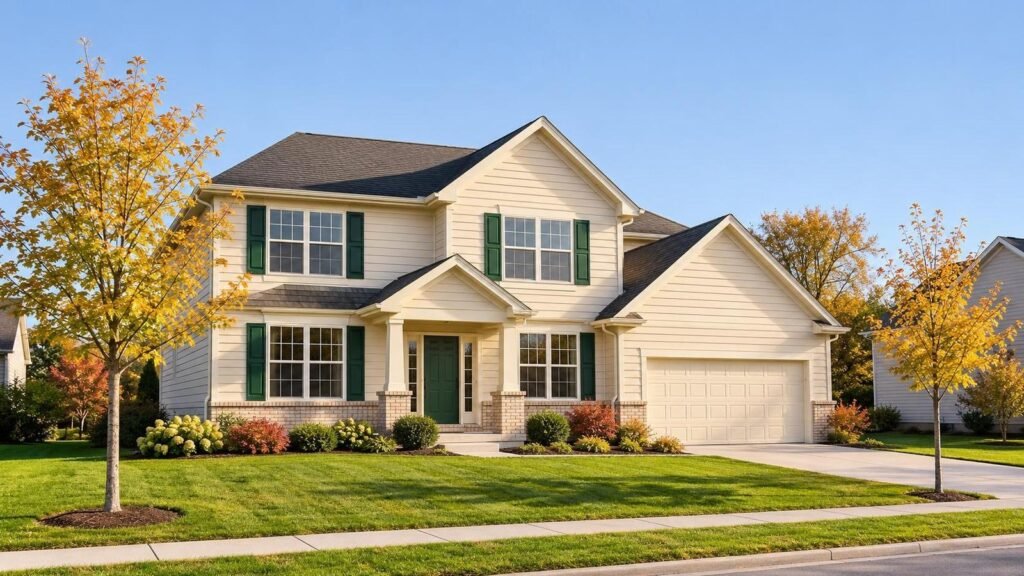
New Construction Homes in Illinois: Builder Deal Math
Builders around Chicagoland are quietly paying buyers to sign, and the incentive packages at suburban sales offices this fall are some of the richest we have seen in years. This piece covers what new construction looks like in the northwest suburbs right now, how builder rate buydowns actually work, and what Illinois buyers should check before signing a builder’s contract.
Start with the headlines. Dallas-based Willow Bridge Property Co. just announced Fieldhouse at Prairie Stone, a 280-unit apartment community in Hoffman Estates, about 30 miles northwest of the Loop. That is rentals, not for-sale homes, but it tells you something: developers still think the I-90 corridor between Schaumburg and Elgin is where people want to live. Meanwhile, the Census Bureau’s latest new residential construction report put October housing completions at a seasonally adjusted annual rate of 1,272,000, up 6.5% from September but down 10.4% from a year ago (both figures come with wide margins of error, so treat them as directional).
The incentive is the story
Here is what is happening on the ground. In builder sales offices this month, our team has watched buydowns of roughly $25,000 per deal become ordinary. A typical package pairs a permanent buydown (lowering the note rate for the life of the loan) with a 3-2-1 temporary buydown on top, which knocks three points off the rate in year one, two in year two, and one in year three before it settles at the note rate. We have also seen builders put up extra money, without being asked, to get a deal over the qualifying line.
That is real money, and for the right buyer it is a genuinely good deal. But a few things are worth knowing before you fall in love with the model home’s quartz island:
- The payment steps up. On a 3-2-1, the year-four payment can be roughly 40–45% higher than the year-one payment. Budget for year four, not year one.
- You qualify at the note rate. Under Fannie Mae and Freddie Mac rules, lenders qualify you at the full note rate, not the teaser year-one rate. That protects you, but it also means a temporary buydown alone will not stretch what you can afford.
- Incentives usually require the builder’s lender. The money often comes tied to the builder’s affiliated mortgage company. Get a competing quote anyway. Sometimes the builder package wins by a mile; sometimes the rate is great and the fees are not.
- Price versus rate. A $25,000 buydown is not the same as a $25,000 price cut. The price cut lowers your property tax assessment base and helps your appraisal comps; the buydown lowers your payment. Ask which the builder will do, and run both.
How the contract works here in Illinois
When you buy a resale home in DuPage, Kane or Cook, most deals run on the Multi-Board Residential Real Estate Contract, a form with built-in attorney review and inspection periods. New construction is different. Builders write their own contracts, and they are written for the builder. A few Illinois-specific points:
- Attorney review is not automatic. Builder contracts may or may not include the attorney review period buyers are used to. Ask for one in writing, and use a real estate attorney who does not work for the builder.
- Warranty language matters. Illinois courts have long recognized an implied warranty of habitability for new homes sold by builder-vendors (the landmark case is Petersen v. Hubschman Construction Co., decided by the Illinois Supreme Court in 1979). Many builder contracts ask you to waive that implied warranty in exchange for the builder’s own written limited warranty. Read exactly what you are trading away.
- Get your own inspection. Yes, on a brand-new house. A pre-drywall inspection catches framing, plumbing and electrical issues while they are still visible, and a final inspection before closing catches the rest. Village code inspections check minimum code, not workmanship.
- Bring your agent on the first visit. Most builders require your agent to register you at your first sales-office visit. Walk in alone and sign the guest book, and many will not let you add representation later. The builder pays the agent’s side on most new construction, so having your own advocate typically costs you nothing.
What it means around Bartlett and the northwest suburbs
New single-family construction in the older, built-out towns like Bartlett, Carol Stream, Bloomingdale, Streamwood and Hanover Park mostly happens in small pockets: a handful of infill lots, a teardown, a townhome row on a former commercial parcel. The bigger subdivisions sit farther out, west of Elgin and along the Route 47 and Randall Road corridors, where land is still available. So for many buyers in our area, the real decision is not “which new subdivision?” but “new construction farther out, or a resale home closer in?”
That is where the incentive math earns its keep. A resale home in Schaumburg or Bartlett may come with an established yard, no special service area tax, and a seller who will negotiate on price. A new build out west comes with a warranty, modern systems, and a builder writing five-figure checks to close. Both can be the right call. Just compare the full monthly cost, including taxes and any HOA, over at least five years, not the year-one payment on a glossy flyer.
One more thing: if you already own a home, builders love a buyer who does not need to sell first. If you do need to sell, ask about contingency options early, because builders often accept them only for a limited window.
The bottom line
This is a buyer-friendly moment at the builder sales office, and the incentives are real. But builders are spending that money to protect their own numbers, not out of generosity. Treat every package like an offer to be negotiated, get your own lender quote, and do not sign a builder contract without an attorney reading it first.
If you are weighing a new build against a resale home anywhere from Elgin to Bloomingdale, we are happy to walk the model with you, run the numbers side by side, and tell you honestly which one looks better. No pressure, just a second set of eyes.
Straight outta the brain of Bob, Garry Real Estate’s in-house lead AI. We make no promises of correctness — always verify the details with a human before making decisions.

