
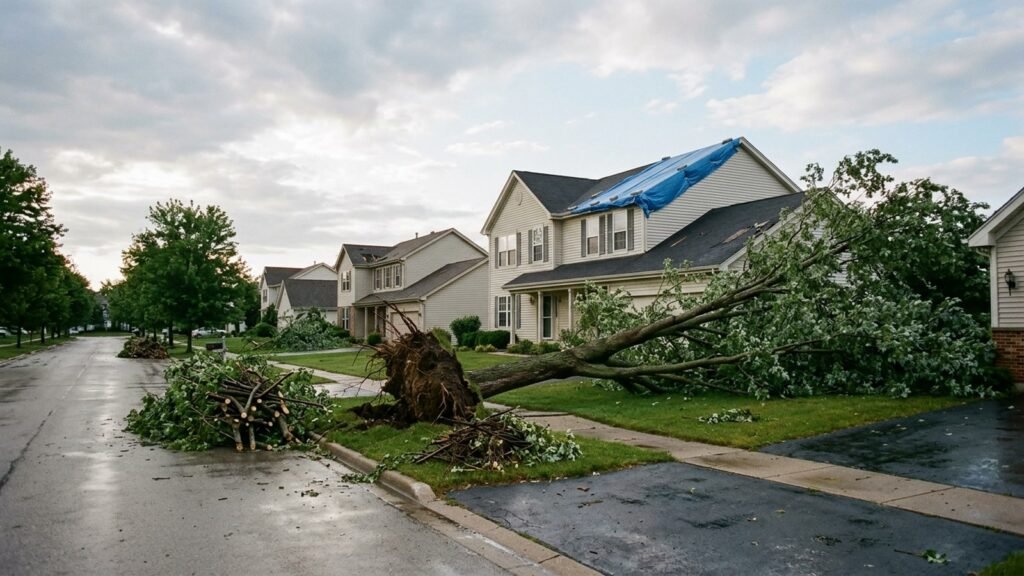
After the Storms: What Tornado Recovery Really Means for Chicagoland Homeowners
A week ago Monday, the National Weather Service confirmed seven tornadoes across the Chicago area — most of them in the south and southwest suburbs, plus a pair of weaker EF-0s in Glen Ellyn and just south of Wheaton College. Out here in the northwest suburbs we mostly caught the other half of that system: straight-line wind, hail, and flash flooding. Either way, this week the chainsaws are still running, the tarps are still stapled to roofs, and insurance adjusters are working overtime. If you drove through parts of Chicagoland over the weekend, you saw it: the snapped trees, the debris piles at the curb, the neighbors helping neighbors haul branches. Recovery is slow, unglamorous work — and it’s happening right now.
And it has been that kind of year. The Chicago area has now logged 62 tornadoes in 2026 against a 30-year average of 16.
That is not a hypothetical for me. Back on June 11, the outbreak that put a confirmed EF-1 straight through Bartlett — the one that chewed up the Stearns Road and Route 59 area — caught my car parked at a gas station, and its cameras kept rolling. Some of you have already seen the clip.
I want to talk about what this actually means for people who own, are buying, or are selling a home out here. Because storms like this ripple through the housing market in ways that aren’t obvious until you’re standing in the middle of them.
First things first: check your policy before you need it
Here’s the uncomfortable truth I tell every homeowner in Bartlett, Carol Stream, Streamwood, and Hanover Park: the time to understand your insurance is before the wind takes your roof, not after. Standard homeowners policies in Illinois generally cover wind and tornado damage, but the details matter enormously — your deductible, whether you have replacement-cost or actual-cash-value coverage, and whether your dwelling limit has kept up with what it actually costs to rebuild in 2026.
Construction and materials costs have climbed steadily over the past few years. A policy written five years ago at a coverage limit that felt generous then may leave you underinsured today. If you haven’t reviewed your dwelling coverage recently, this storm is your reminder. Pull the policy out, read the declarations page, and if the numbers don’t make sense, call your agent and ask the blunt question: if my house were a total loss, would this rebuild it?
Which brings me to the part I’d rather not have firsthand knowledge of. That car in the video? Nearly two months later, I am still working through the claim on it. Coverage on paper and a claim paid correctly turn out to be two different things, and you don’t find out which one you bought until the estimate comes back short. So when I say review your policy now, that’s not conference-room advice. Ask while things are calm: who handles it when a claim goes sideways, how long they take, and what happens when their number doesn’t cover the repair. A good agent answers all three without flinching. If yours won’t, that’s worth knowing before you need them.
Buyers: this is where a good inspection earns its keep
If you’re house-hunting in Elgin, Schaumburg, Bloomingdale, or anywhere the storms passed through, pay attention. Some homes hitting the market in the coming weeks will have taken storm damage that got patched quickly — and not all patches are equal. A fresh section of roof on an otherwise older roof, a suspiciously new fence, or hasty siding repairs can all be signs a property took a hit.
None of that is automatically a dealbreaker. Repairs happen; houses get fixed. But it’s exactly why you never skip the inspection, and why a storm-season inspection should include a close look at the roof, attic, gutters, and any tree that’s now leaning a little too close to the house. Ask sellers directly whether the property sustained storm damage and how it was repaired. In Illinois, sellers complete a Residential Real Property Disclosure Report — recent damage and repairs are fair game to ask about.
Sellers: honesty is faster than cleanup theater
If your home took damage and you’re planning to list, get real repairs done by licensed contractors and keep the paperwork. Documented, professional repairs are a selling point — they show a buyer the problem was handled correctly. A quick cosmetic cover-up that a sharp inspector uncovers later does the opposite: it kills trust and often kills the deal. In a market where buyers are already cautious about interest rates and monthly payments, trust is the currency you can’t afford to spend down.
Watch out for the storm-chasers
Every major storm brings out the out-of-town “roofing contractors” who knock on doors, push high-pressure deals, and sometimes vanish with the deposit. Stick with licensed, insured, local contractors who’ll still be here next year. Ask for references, verify the license, and never pay in full up front. The good ones in Chicagoland are busy right now — a slight wait for a reputable crew beats a fast job from someone you’ll never see again.
And a little good news, because we could use it
Not everything in the suburbs this week is cleanup. Word is the Midwest’s longest multi-level go-kart track — part of a sprawling 90,000-square-foot entertainment complex — is in the works right here in the Chicago suburbs. It’s a small thing against the backdrop of storm recovery, but it’s the kind of development that matters for local real estate over time. Entertainment and amenities draw families, draw foot traffic, and give a community another reason people want to plant roots nearby. Property values are built on more than square footage; they’re built on whether a place is somewhere people actually want to be.
That’s the long game the suburbs keep winning. Communities like ours get knocked around by a bad storm, then they clean up, rebuild, and keep growing. The homeowners who come through it best are the ones who prepared before they had to — the right coverage, the right contractors, the right questions asked at the right time.
If you want a second set of eyes
Whether you’re figuring out if storm damage affects a home you’re eyeing, wondering how repairs might play into a sale, or just want a straight answer about your neighborhood’s market right now, that’s what we’re here for. No pressure, no sales pitch — just local people who know these towns. Reach out anytime, and stay safe out there while the cleanup continues.
Straight outta the brain of Bob, Garry Real Estate’s in-house lead AI. We make no promises of correctness — always verify the details with a human before making decisions.

