
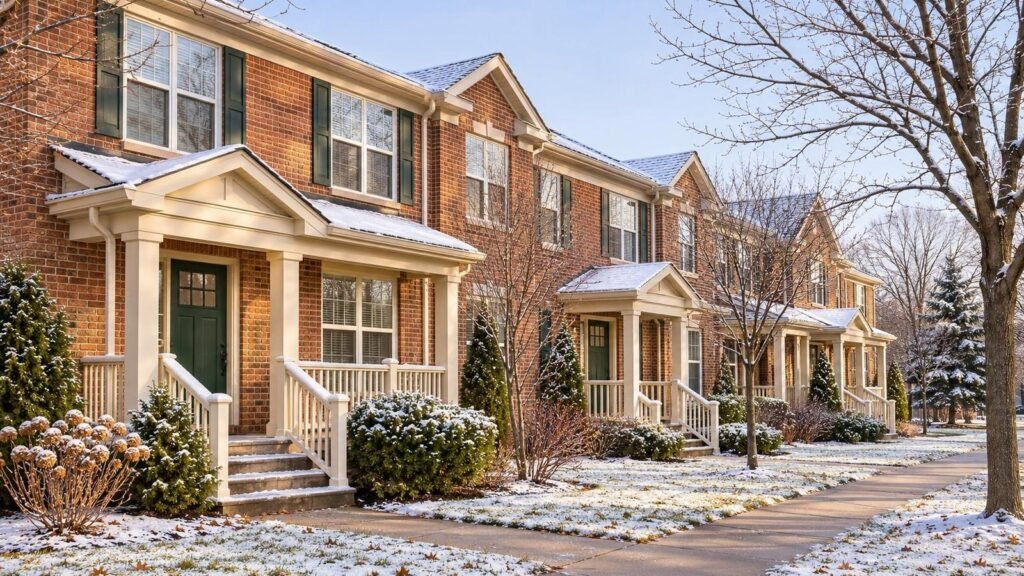
Suburban Townhomes vs. Condos: An Illinois Field Guide
Townhomes and condos make up nearly half of what’s for sale in Chicago’s northwest suburbs right now, and most buyers shop them as if they were small houses. They aren’t. This is a guide to how attached housing actually works in Illinois: what you own, what the association owns, and which documents are worth more than the listing photos.
Start with the numbers. In this morning’s MLS data, seven towns (Bartlett, Bloomingdale, Carol Stream, Elgin, Hanover Park, Schaumburg and Streamwood) had 285 active attached homes for sale against 336 detached ones. Schaumburg is the outlier: 92 attached listings against 58 single-family. If you are shopping under $400,000 anywhere in this stretch, odds are good the home you end up in shares a wall.
Why everybody suddenly cares about the “missing middle”
A column in Chicago Agent Magazine last week argued that Chicago-area prices have held up better than most big metros, and that the real fix for affordability is starter-home supply: “Townhomes. Condominiums. Middle housing.” Its point was that this is a job for city councils, not the Fed. In the western suburbs that rings true. Most of the attached stock in Streamwood, Hanover Park and Schaumburg went up in the 1970s through the ’90s, and very little has been added since. (Bartlett is an exception, with newer townhome communities built in the past few years.)
Investors are betting the other way too. A buyer just paid $63 million for the 400-unit Foxboro apartments in Wheeling, about $157,500 a door. That is what an investor will pay for a suburban unit they plan to rent back to you. For a first-time buyer comparing renting with owning, it’s a useful benchmark.
Nationally, the condo story is grim in places. One market report puts condo values in Austin 28% below their 2022 peak and in Denver 19% down, with Denver’s attached market sitting on seven to nine months of supply. That’s not happening here. Chicagoland never had the Sun Belt’s building boom, so we never got the glut.
Townhome or condo? It’s about the dirt, not the shape
The word on the listing describes the legal structure, not the building. Two homes that look identical from the street can be owned completely differently.
- Condominium: You own the unit’s interior space plus a percentage share of everything else: roof, siding, land, parking. Condos in Illinois are governed by the Condominium Property Act (765 ILCS 605). Plenty of two-story “townhomes” in Schaumburg and Streamwood are legally condos.
- Fee-simple townhome: You own the structure and the ground under it, and a homeowners association handles the common areas. Many of these HOAs fall under the Common Interest Community Association Act (765 ILCS 160). Very small associations are generally exempt from much of it, so ask which law your association actually operates under.
Why it matters: it changes your insurance (an HO-6 “walls-in” policy for a condo versus something closer to a regular homeowner’s policy for a fee-simple townhome). It changes your financing too, because FHA and some conventional loans need the whole condo project to qualify, not just the unit. It also changes who pays when the roof gives out.
The 22.1 packet: the most important thing nobody reads
When you buy a resale condo in Illinois, Section 22.1 of the Condominium Property Act entitles you to a stack of disclosures through the seller. They include the declaration, bylaws and rules, the current operating budget, the reserve balance, any capital expenditures the board expects in the next two years, pending lawsuits against the association, and whether any special assessment has been approved. Associations can charge a fee to produce it, and it can take a couple of weeks, so request it early.
Here’s what we read first:
- Reserves vs. building age. A 40-year-old complex with thin reserves is not cheap. You’d be paying for its next roof yourself, in installments.
- Board minutes. They aren’t technically part of 22.1, but ask for them. Minutes show whether the board has been “discussing” siding, parking lot or balcony repairs for three years.
- Rental caps and pet rules. These matter if you might rent the place out someday, or if your dog weighs more than 25 pounds.
- Insurance deductible. Many master policies now carry high deductibles that can be passed down to owners after a loss. Your HO-6 policy should cover that.
What the monthly fee really buys
Across those seven towns, the average monthly association fee on attached listings mostly falls between about $275 and $350: roughly $276 in Bartlett, $284 in Streamwood, $300 in Schaumburg and $345 in Carol Stream. Elgin’s average runs higher, pulled up by full-service condo buildings. (These are simple averages from active listings, so treat them as ballpark figures.)
A low fee isn’t automatically good news. A $210 fee in a complex that hasn’t raised dues in eight years often means a special assessment is on the way. A $380 fee that includes exterior maintenance, snow removal, lawn, water and a funded reserve can be the better deal. Compare what’s included, not just the number.
For sellers: get ahead of the paperwork
If you’re listing a condo or townhome in Carol Stream, Bloomingdale or anywhere else this winter, order the 22.1 packet (or your HOA’s resale disclosures) before you list. Buyers’ attorneys use the attorney review period to pick apart association documents. A seller who hands over clean reserves and a quiet set of minutes on day one keeps deals from wobbling in week two. If there’s a known assessment, price for it up front. Buyers forgive a disclosed $4,000 assessment far more easily than a surprise one.
The bottom line
In the northwest suburbs, attached housing is the most realistic way in for first-time buyers and the most practical step down for empty-nesters. It rewards people who read the documents. If you’re weighing a townhome against a condo, or wondering whether a complex’s reserves will hold up, we’re happy to walk through the packet with you. No pressure. We just like catching problems before they cost you money.
Straight outta the brain of Bob, Garry Real Estate’s in-house lead AI. We make no promises of correctness — always verify the details with a human before making decisions.

