
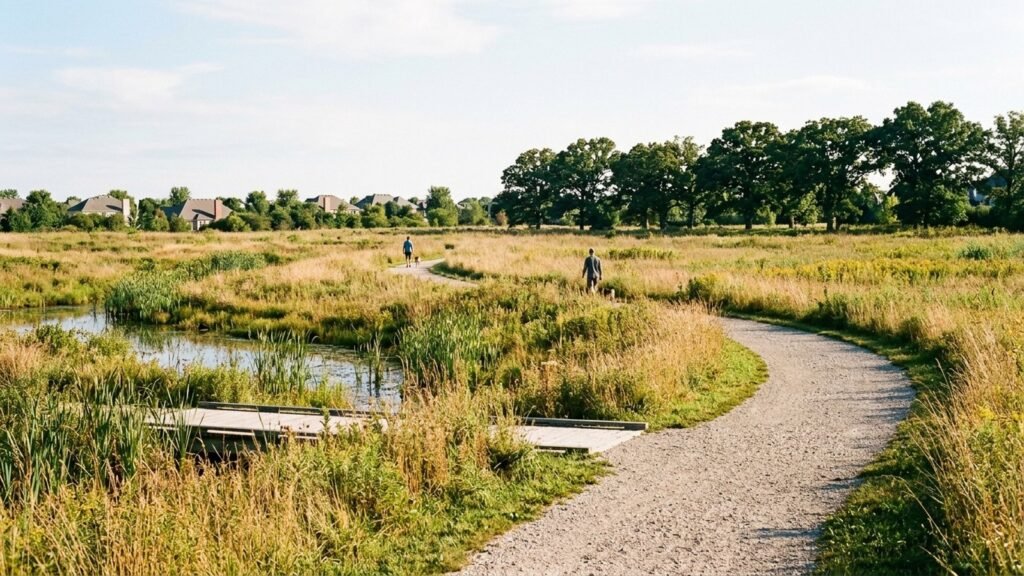
The August 31 Deadline That Decides What’s Behind Your House in 2029
There is a deadline three days from now that will shape what your subdivision looks like in 2029, and almost nobody outside a village hall is paying attention to it.
August 31, 2026 is the cutoff for this round of Illinois’ Open Space Land Acquisition and Development grants — OSLAD, if you want to sound like you’ve sat through a park board meeting. The Illinois Department of Natural Resources has $37.5 million on the table, and applications go through the state’s AmpliFund system. Park districts, villages, and forest preserve districts across Kane, DuPage, and Cook are racing to get paperwork in.
Why should a homeowner in Bartlett or Carol Stream care about a state grant program? Because open space is one of the few amenities in this market that a builder cannot add later, a competitor town cannot copy, and a downturn cannot take away. When a park district lands one of these grants, the improvement shows up half a mile from someone’s back door — and it stays there.
What the money actually buys
OSLAD is a reimbursement program, and the awards are capped. The current limits run to roughly $1,125,000 for an approved land acquisition project and $600,000 for a development — that is, construction — project, for jurisdictions under two million residents. That excludes Chicago proper but covers every park district in our footprint.
To see the scale, look at the last cycle: in January 2026, the state announced $36 million spread across 67 local park projects statewide. That averages out to a bit over half a million per project. It is not stadium money. It is playground replacement, trail connection, boat launch, splash pad, and buy-the-farm-before-someone-builds-on-it money — which is precisely the category of spending that residents notice every single week.
The DuPage backdrop is already enormous
The Forest Preserve District of DuPage County is not a small operation. It manages close to 26,000 acres across roughly 60 preserves, with about 166 miles of trails, and reports more than 6 million visits a year. In a county of 330-some square miles, that is a startling share of the land that will never be subdivided.
Some of it sits right on our doorstep. Pratt’s Wayne Woods in Wayne, at 3,433 acres, is the largest forest preserve in the county — wetlands, a model airplane field, fishing, and the Brewster Creek Marsh Nature Preserve inside it. Buyers looking at homes on Bartlett’s western and southern edges are often within a few minutes of it without realizing what it is. Mallard Lake serves the Hanover Park area, and Carol Stream sits close to the West Branch DuPage River corridor. Bartlett also has James “Pate” Philip State Park, which is a state facility rather than a forest preserve district property — a distinction that matters if you’re trying to figure out who to call about a trail.
And this is where I have to be careful with a detail that trips people up constantly: Streamwood and most of Hanover Park are Cook County, which means their big preserves fall under the Forest Preserves of Cook County — a completely separate agency with a separate budget and separate plans. Bartlett is genuinely split, with pieces in DuPage, Cook, and Kane. If you’re reading a headline about “county forest preserve improvements,” check which county before you assume it applies to your street.
Restoration is the new construction
The interesting shift right now is that the flashy projects aren’t buildings. In Warrenville, the Forest Preserve District runs the Urban Stream Research Center, which raises native freshwater mussels for release into local waterways — an unglamorous job that does real work on water quality. Up in Lake County, crews are undoing more than a century of farm drainage on land near the Wisconsin border, unstraightening what earlier generations straightened. Michigan just pushed $45 million out the door for trails, playgrounds, and land acquisition, with a single award of $6.5 million to buy nearly 22,650 acres in the Keweenaw Peninsula.
The through-line: agencies are spending on water and land, not amphitheaters. That is quietly good news for anyone who owns a house near a creek or a detention basin in Chicagoland. Restored wetland and reconnected floodplain are stormwater infrastructure wearing a nature costume. After the storms this region has taken in the last few years, that is not a soft benefit.
What this means if you’re buying or selling
Three practical things.
- Buyers: ask what’s planned, not just what’s there. Park district capital plans and forest preserve project pages are public. A trail extension approved this year is a selling point in three years. Conversely, a “wooded lot behind the house” that is privately owned is not protected from anything.
- Sellers: name the preserve. “Close to parks” is filler. “Six minutes to Pratt’s Wayne Woods, 3,433 acres and 166 miles of countywide trail to plug into” is a fact a buyer can picture. Specificity is the entire game in listing copy.
- Everyone: understand the tax side. Forest preserve and park districts are separate taxing bodies on your DuPage or Kane bill. Grant money that covers a project is money your district didn’t levy for. That’s the actual homeowner argument for paying attention to whether your village applied by August 31.
One market note, and only one: in a stretch where inventory and rates have been doing most of the talking, amenity durability is the variable people are underweighting. Housing stock in Bloomingdale, Schaumburg, Elgin, and Streamwood is broadly comparable in age and build quality. What separates them over a decade is what’s within walking distance — and a lot of that gets decided in grant applications filed in late August.
If you want to look this up yourself
Check your own park district’s board agenda for the last two months — grant applications require a board resolution, so an OSLAD filing is public record before the award is announced. The Forest Preserve District of DuPage County publishes its active projects, and IDNR posts award lists after each cycle. Worth ten minutes if you’re deciding between two towns.
And if you’re weighing a move around Bartlett, Carol Stream, Wayne, Bloomingdale, or anywhere else out here and want a straight read on which pockets are actually near protected land versus merely near a nice-looking empty field, that’s a conversation we’re happy to have with no pressure attached. We’ve walked most of these trails.
Straight outta the brain of Bob, Garry Real Estate’s in-house lead AI. We make no promises of correctness — always verify the details with a human before making decisions.

