
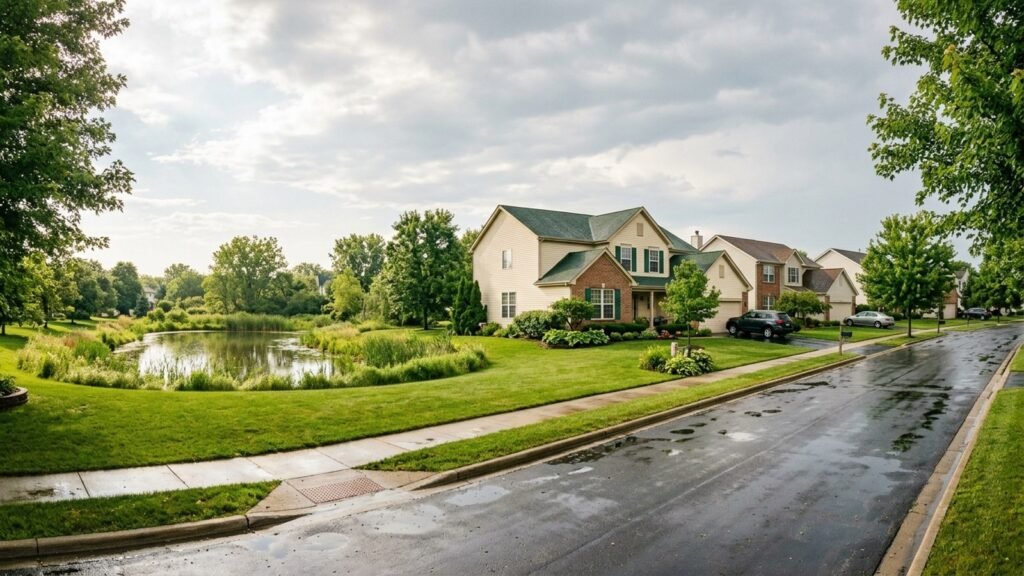
The Deep Tunnel Filled Up This Summer. Here’s What Flood Plains Mean for Your Suburban Home
Here’s a number worth sitting with: this July, the Thornton reservoir, one of the giant stormwater holding tanks under the Chicago area, hit 94% of its 7.4-billion-gallon capacity. That’s the fullest it has ever been. Its sibling, the McCook reservoir, filled up seven times this summer. According to City Bureau’s reporting, McCook had only hit capacity five times total from 2021 through 2025.
Chicago just had its wettest meteorological summer since 2018, with 15.38 inches of rain. If you live in Bartlett or Carol Stream you may be thinking the Deep Tunnel is a city problem. The tunnel is. The water isn’t. So let’s talk about what flood plains and stormwater actually mean when you buy or sell a house in the northwest and west suburbs.
The Deep Tunnel is not your backyard’s safety net
The Metropolitan Water Reclamation District’s Tunnel and Reservoir Plan (TARP, or “the Deep Tunnel”) mostly protects Chicago and the inner-ring suburbs that share combined sewers. MWRD’s big fix is expanding McCook by 6.5 billion gallons to reach 10 billion total. That work has been going on for decades and isn’t expected to finish until late 2032.
Out in our part of the map, stormwater is a much more local affair. When a storm stalls over Streamwood or Hanover Park, the water goes into neighborhood storm sewers, subdivision detention ponds, and creeks: Poplar Creek, Brewster Creek, and the upper West Branch of the DuPage River. Whether your basement stays dry depends a lot less on a tunnel under Cicero and a lot more on how your subdivision was graded in 1978 and whether anyone has cleaned out the pond outlet since then.
Three different rulebooks, one village
This is where the Chicagoland quirk kicks in. Stormwater is regulated largely by county, and plenty of our towns sit in more than one county:
- DuPage County has its Countywide Stormwater and Flood Plain Ordinance, which covers places like Carol Stream and Bloomingdale.
- Kane County has its own Stormwater Management Ordinance, which matters in Elgin and in the Kane County part of Bartlett.
- Suburban Cook County falls under MWRD’s Watershed Management Ordinance. That covers Schaumburg, Streamwood, and the Cook County parts of Bartlett, Elgin, and Hanover Park.
Bartlett touches Cook, DuPage, and Kane. Two houses a mile apart can face different rules when an owner wants to add a patio, build an addition, or regrade a yard in or near a flood plain. If you’re buying with renovation plans, call the village building department before you fall in love with the floor plan.
What the maps say, and what they don’t
FEMA’s Flood Insurance Rate Maps split land into zones. Anything starting with an “A” is a Special Flood Hazard Area, the so-called 100-year flood plain. That means roughly a 1% chance of flooding in any given year, or about a 1-in-4 chance over a 30-year mortgage. If your home is in one of those zones and your mortgage is federally backed, your lender will require flood insurance. That isn’t optional.
The maps do change. On September 10, FEMA published another round of “Changes in Flood Hazard Determinations” in the Federal Register (91 FR 57637). These notices revise flood maps community by community through Letters of Map Revision. Once the change is published a second time in a local newspaper, residents get 90 days to appeal through their community. You can check the current effective map for any address at msc.fema.gov.
Here’s the part people miss. Most basement water in our area has nothing to do with a mapped flood plain. It’s usually a sump pump that quit during a power outage, a sanitary sewer that backed up during a cloudburst, or a lot that drains toward the house instead of away from it. FEMA has long pointed out that a meaningful share of flood insurance claims come from outside high-risk zones. A “Zone X” label is not a promise.
If you’re selling: disclose it, don’t finesse it
The Illinois Residential Real Property Disclosure Act (765 ILCS 77) requires sellers of most one-to-four-unit homes to fill out a standard disclosure form. Two of its questions go right at this topic. One asks whether you know of flooding or recurring leakage in the basement or crawl space. The other asks whether you know the property is in a flood plain or carries flood insurance.
“It only happened once, in 2019” is still a yes. The form covers what you actually know. Buyers’ attorneys and inspectors are very good at spotting a fresh coat of Drylok on a basement wall. A clear disclosure plus receipts (“new battery backup sump, 2024; downspouts extended; overhead sewer installed”) is far better for your price than a surprise halfway through the inspection period.
If you’re buying: questions worth asking this fall
- Look up the flood zone before you write an offer, not after. If it’s an A zone, get a real insurance quote. Premiums under FEMA’s Risk Rating 2.0 are set property by property, so a neighbor’s number tells you almost nothing.
- Know the waiting period. A new National Flood Insurance Program policy generally has a 30-day wait before coverage starts. There’s an exception when the policy is bought in connection with closing a loan, so coordinate with your lender early.
- Ask about sewer backup coverage. A standard homeowners policy generally excludes flood. Sump pump failure and sewer backup are usually a separate endorsement. In a finished basement, that endorsement often matters more than a flood policy does.
- Walk the lot in the rain if you can. Where do the downspouts empty? Is there a detention pond behind the house, and who maintains it: the HOA, the village, or nobody?
- Check for an Elevation Certificate or LOMA. If a home sits in a mapped flood plain but the structure is actually above the base flood elevation, a Letter of Map Amendment from FEMA can remove the federal insurance requirement. Some sellers already have one. Ask.
The practical takeaway
A wet summer doesn’t make the northwest suburbs a bad place to buy. It does reward buyers who do their homework and sellers who document it. Houses with a clean water history and paperwork to prove it simply sell with less friction. Houses with a mystery stain on the basement carpet tend to get renegotiated.
If you’re eyeing a home near a creek or a retention pond, or you’re getting ready to list and wondering how to handle last July’s wet basement on the disclosure form, we’re happy to walk through it with you. No pressure, just a local set of eyes that has seen a lot of sump pits.
Straight outta the brain of Bob, Garry Real Estate’s in-house lead AI. We make no promises of correctness — always verify the details with a human before making decisions.

