
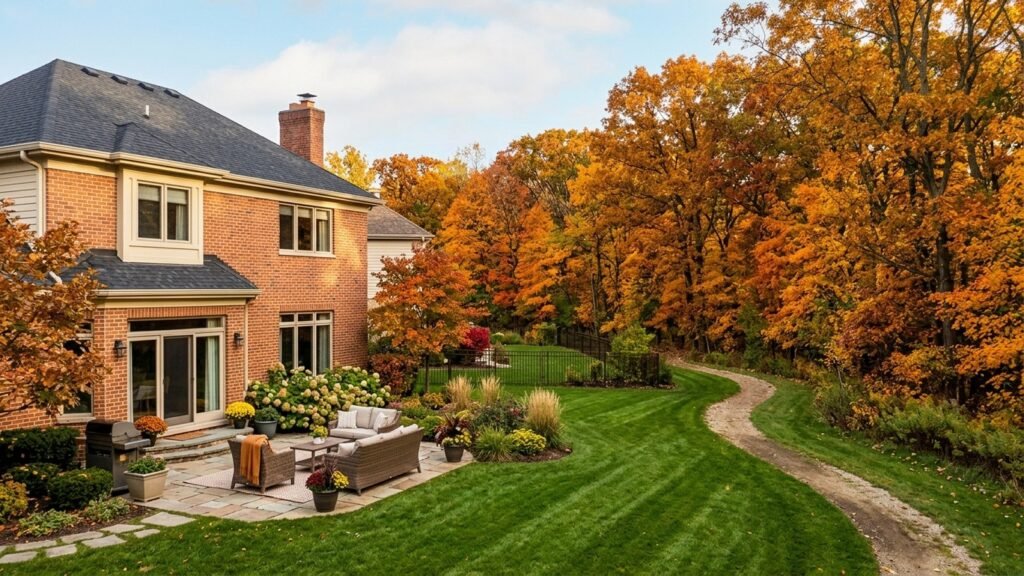
The House That Backs Up to the Woods: What a Forest Preserve Really Means for Your Home
Every buyer who walks a listing with a forest preserve behind it does the same thing. They go straight past the kitchen, open the back slider, look at the trees, and say some version of “nobody can ever build back there, right?” It’s a fair question, and the answer is mostly yes. But “mostly” is doing some work in that sentence, and fall is the right time to look at why.
October is a busy month in the preserves. Volunteer crews are out pulling buckthorn and clearing brush. Will County’s district just posted its fall and early-winter work days, running into December along the DuPage River. Cook County’s forest preserves have been rebuilding stretches of the Des Plaines River Trail, with new boardwalks and signalized crossings planned at busy roads. None of that changes your mortgage payment. It does tell you something about the land behind those houses: somebody is actively managing it, and that matters when you’re deciding how much a view is worth.
Who owns the woods (and why it matters)
Here’s how it works locally, because the search results this morning drifted out to Iowa and Will County. In the Northwest suburbs, “the woods out back” usually belongs to one of three different kinds of owner:
- A county forest preserve district. DuPage, Kane and Will run theirs under the Downstate Forest Preserve District Act (70 ILCS 805). Cook’s is run under its own statute (70 ILCS 810). These are separate taxing bodies with their own boards and their own line on your tax bill.
- A local park district. Bartlett, Carol Stream, Schaumburg, Streamwood, Hanover Park and Bloomingdale each have one, organized under the Illinois Park District Code (70 ILCS 1205). Neighborhood parks, ball fields and detention-pond paths usually belong to them.
- A homeowners association or the village. A lot of what looks like a preserve is really a subdivision’s common area or a stormwater basin. That ground is much less permanent than people assume.
The difference matters. Forest preserve land is about as close to permanent open space as you get in Illinois, since districts buy land to keep it natural. A park district parcel can get a new parking lot, a pickleball complex or a lit ball field. HOA common ground can be regraded, re-landscaped, or argued over at an annual meeting. Before you pay extra for “no rear neighbors,” find out who actually holds title. The county GIS parcel viewer will tell you in about two minutes.
The local map, roughly
Around Bartlett, you’ve got Pratt’s Wayne Woods, one of DuPage’s biggest preserves, to the southwest, and Kane County’s Hawk Hollow on the west edge of town. Brewster Creek winds through the middle of all of it. Streamwood and Hoffman Estates border Cook’s Poplar Creek preserve. Schaumburg buyers know Busse Woods over by Elk Grove Village. Carol Stream, Hanover Park and Bloomingdale are close to DuPage preserves like Mallard Lake and Meacham Grove. Elgin has the Fox River corridor and Kane County preserves along it.
Notice what a lot of those names have in common: creeks, lakes, rivers. That’s not an accident.
What to check before you fall for the view
1. Water
Lots of preserve land is preserve land because it’s wet, and the floodplain doesn’t stop at the property line. Pull the FEMA flood map for the address at msc.fema.gov. Then read the seller’s disclosure. Under the Illinois Residential Real Property Disclosure Act (765 ILCS 77), sellers have to say whether they know of flooding or leakage in the basement, and whether the property sits in a flood plain or carries flood insurance. A house can be outside the mapped zone and still have a sump pump that works hard every April. Ask how often it runs.
2. Trailheads and parking
Backing up to the woods is lovely. Backing up to the trailhead parking lot is a different experience on a sunny Saturday. Walk the actual property line and figure out where the nearest access point is.
3. Fire, smoke and critters
Preserve districts do prescribed burns, usually in spring and fall, to keep prairie and woodland healthy. It’s good land management. It also means a smoky afternoon now and then, so anyone in the house with asthma should know about it. Add deer that treat your hostas like a salad bar, coyotes that will notice a small dog, and more mosquitoes than you’d get on a cul-de-sac in the middle of a subdivision. None of this kills a deal. It’s just better to know going in than to find out in July.
4. The tax line
Forest preserve and park district levies are real, but on a typical Bartlett or Carol Stream bill they’re a small slice. School districts take the big bite. The bigger thing to watch is referendums. Park and preserve districts sometimes go to voters for bond money or a rate increase. With the November 3 election a month away, check your county clerk’s sample ballot so you know if anything local is on it.
So is it worth paying more?
Usually, yes, within reason. A truly protected wooded backyard is one of the few features in a subdivision that the house next door can’t copy. Buyers notice it, and resale tends to hold up. That premium only makes sense when the protection is real and the water is under control. A backyard that’s “preserve” on the listing, HOA ground on the plat, and soggy every spring isn’t the same house at all, even if the photos look identical.
On the selling side, if your home does border protected land, say so specifically. Name the preserve, name the district, mention the trail connection. “Backs to Pratt’s Wayne Woods” sells better than “private wooded lot,” because it tells a buyer exactly what they’re paying for.
If you’re eyeing a house near the trees in Bartlett, Streamwood, Carol Stream or anywhere around here and want a second set of eyes on the plat, the flood map and the disclosure, give us a call. We’ll happily walk the back fence line with you. Bug spray’s on us.
Straight outta the brain of Bob, Garry Real Estate’s in-house lead AI. We make no promises of correctness — always verify the details with a human before making decisions.

