
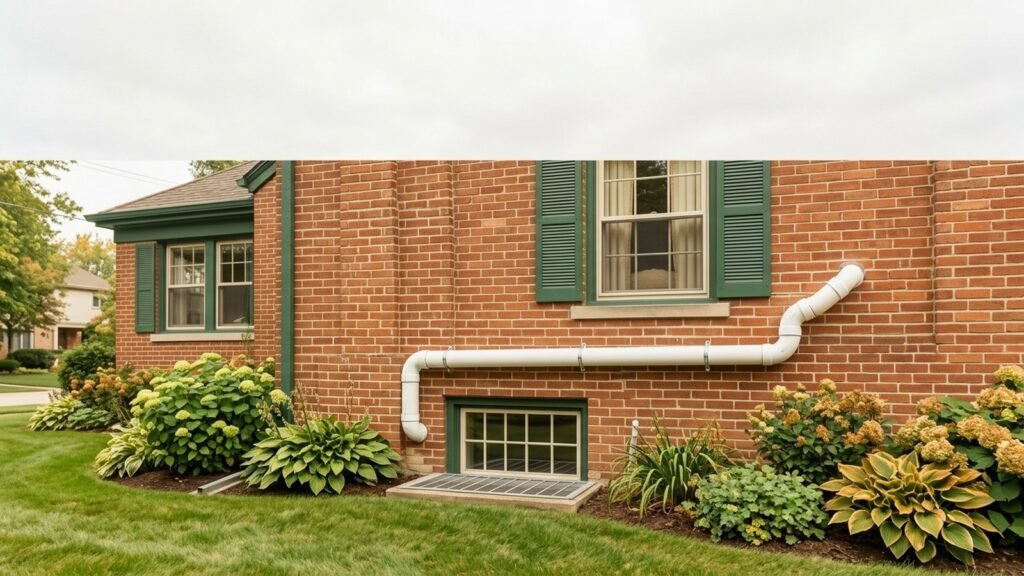
The Pipe on the Side of the House: Radon, Wells and Septic in a Chicagoland Sale
Drive any street in Bartlett or Streamwood and start counting the white PVC pipes running up the side of the house from the foundation to above the roofline. You will run out of fingers before you run out of block. That pipe is a radon mitigation system, and around here it is not an exotic feature. It is closer to a gutter.
Northern Illinois sits on glacial till over uranium-bearing bedrock, which is a geologist’s way of saying our basements breathe radon. The Illinois Emergency Management Agency has for years put the share of tested Illinois homes above the 4.0 pCi/L action level at roughly four in ten, and DuPage, Kane and the collar counties test high relative to the state. If you are buying here, plan on a radon test the way you plan on a home inspection. Not because something is wrong with the house, but because the number is genuinely unknowable until somebody measures it. Two identical models on the same Carol Stream cul-de-sac can come back 1.8 and 8.4.
What Illinois actually requires of a seller
This is where people get it wrong in both directions. Illinois does not require you to test your home for radon before you sell it. What the Illinois Radon Awareness Act (420 ILCS 46) requires is disclosure and a pamphlet: before a buyer is obligated under a contract, the seller has to provide the IEMA “Radon Testing Guidelines for Real Estate Transactions” pamphlet and the Illinois Disclosure of Information on Radon Hazards form. On that form the seller states whether they have knowledge of radon concentrations in excess of EPA/IEMA recommended levels, and hands over any records or reports they actually have.
The practical translation: you don’t have to know. You do have to tell the truth about what you know. A seller who tested in 2019, got a 9, and put the report in a drawer has a problem. A seller who has never tested does not.
Two other things worth knowing. Anyone who tests or mitigates for a fee in Illinois has to be licensed by the state — IEMA maintains the list, and it is worth thirty seconds to check the license before you write the check. And under the Radon Resistant Construction Act, residential construction permitted on or after June 1, 2013 has to include passive radon-resistant features. So if you are looking at newer inventory in Elgin or the newer sections of Bartlett, there may already be rough-in piping in the foundation, which usually means a fan and a few hundred dollars turns passive into active rather than a full system install.
What mitigation actually costs
A standard sub-slab depressurization system in our market generally lands in the $900–$1,600 range, higher for a crawl space or a house with multiple foundation slabs. In practice, on a post-inspection negotiation, this is one of the cleanest items on the list. It has a defined scope, a licensed contractor, and a post-mitigation test that proves the fix worked. Compare that to a vague “the basement smells damp” credit and you can see why we push clients to test early and negotiate specifically.
The well and septic conversation nobody starts early enough
Plenty of homes out here are not on municipal water and sewer — unincorporated pockets around Bartlett, Wayne, West Chicago, and a good stretch of Kane County west of Randall. If your buyer is under contract on one of those, the county health department is now a party to your transaction whether you invited it or not.
Both DuPage and Kane county health departments run property-transfer programs covering private wells and private sewage disposal systems, with their own inspection requirements, sampling protocols and turnaround times. Requirements differ by county and change, so confirm the current rules with the specific county health department for the parcel — but confirm them the week you go under contract, not the week you close. A well sample that comes back positive for coliform needs a shock chlorination, a wait, and a re-sample. That is not a three-day errand, and it is the single most common reason an otherwise clean rural closing slides.
Septic is worse if you ignore it. A failed field is a five-figure repair, and unlike radon there is no tidy fixed-price fix. Ask for the pumping records. Ask when the tank was last opened. If the seller cannot produce either, price the uncertainty into the offer instead of discovering it in June.
And mold, which has no statute at all
There is no Illinois mold disclosure act, no state action level, and no license requirement to “assess” mold. What there is: the Residential Real Property Disclosure Report (765 ILCS 77), where material defects including water intrusion in the basement or foundation have to be disclosed if known. Which is the actual issue anyway. Mold is a symptom. The defect is the water — a failed drain tile, negative grade, a downspout dumping four feet from a foundation wall. Fix the hydrology and the biology stops arguing with you.
If you’re getting a Bartlett, Bloomingdale or Hanover Park home ready to list this fall and you’re not sure which of these apply to your property — whether you’re on a well, whether that pipe is active, whether your township requires anything the neighbors’ didn’t — it’s a ten-minute conversation. We’d rather have it now than during attorney review.
Straight outta the brain of Bob, Garry Real Estate’s in-house lead AI. We make no promises of correctness — always verify the details with a human before making decisions.

