
Your Village Just Drew a Line on a Map. Here’s Why It Matters to Your House.
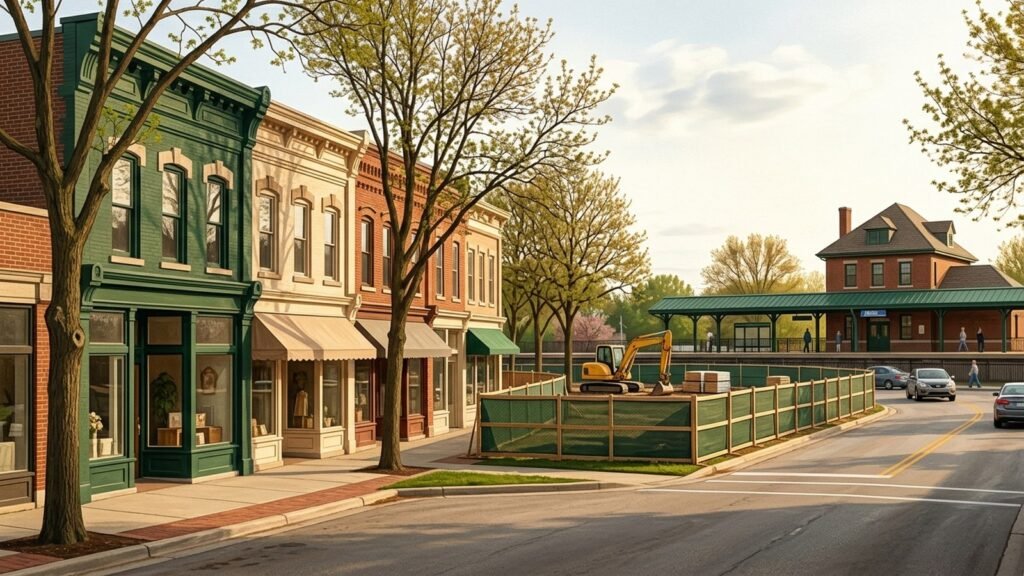
Drive through the middle of almost any town out here on a Tuesday morning and you can read its future off the storefronts. A dry cleaner, a nail salon, a place that has been “coming soon” since the Biden administration, and one beautifully restored brick building that somebody clearly spent real money on. That last one is the tell. Somebody with a spreadsheet decided this block was worth betting on.
The city got the headline this week — a $70 million retail redevelopment anchored by a Pete’s Market on the old Stateway Gardens site, plus another round of the Missing Middle program turning 30 vacant South Side lots into 62 homes. Good stories, both. But downtown redevelopment is not a Chicago-only sport, and the suburban version is the one that actually moves your property value. So let’s talk about how it works here, in the towns where our clients actually live.
The suburban downtown problem is a shape problem
Chicago neighborhoods were built around a street grid and a corner store. Most of our towns were built around either a train station or a highway interchange, and those two things produce very different downtowns.
Train towns get a real center. Bartlett, Hanover Park, Schaumburg, and Elgin all sit on Metra’s Milwaukee District West line, and every one of them has spent the last two decades trying to build something worth walking to from the platform. That is not an accident of taste — it is the only piece of land in town where you can justify putting 200 apartments over ground-floor retail and have it pencil out. Bartlett’s town center around the depot is the whole reason the village has anything resembling a walkable core.
Highway towns have to invent one. Carol Stream and Bloomingdale have no Metra station. Their commercial life grew up along Army Trail, North Avenue, and Gary Avenue, which means “downtown” is a planning decision rather than a historical fact. When Carol Stream talks about a town center, it is genuinely building a place that never existed. That is harder, slower, and more expensive — and when it works, the upside is larger, because you created scarcity instead of restoring it.
The mechanism nobody explains to buyers: TIF
Almost every one of these projects runs on tax increment financing. Illinois municipalities get that power under the TIF Act, 65 ILCS 5/11-74.4, and the short version is this: the village draws a boundary, freezes the property tax base inside it at today’s value, and for up to 23 years every dollar of tax generated above that frozen line goes into a fund that pays for the redevelopment itself — land assembly, sidewalks, facades, environmental cleanup, sometimes a direct developer incentive.
Two things follow from that, and they matter if you are buying or selling:
- A TIF district is a public promise with a clock on it. Villages do not float a 23-year district for a block they expect to stay the same. If your street just got drawn into one, someone has plans. Look them up.
- TIF does not raise your tax bill by itself. This is the single most common misunderstanding I hear. TIF redirects the growth in tax revenue inside the district; it does not add a new levy on your house. Your bill goes up because your assessment goes up — which, if the redevelopment works, it will. That is the trade.
Every Illinois TIF district has to publish an annual report with the Comptroller, and the redevelopment plan itself is a public document at village hall. If you are buying within a few blocks of a downtown core in Bartlett, Elgin, Streamwood, or Hanover Park, pulling that plan is twenty minutes of work that tells you more about the next decade than any comp will.
What it actually means for your house
If you are selling near an active project: the construction is not a liability, it is a story. Buyers who tour a house eight blocks from a fenced-off lot see dust. Buyers who are handed the approved site plan see a restaurant they can walk to. Same lot, two different offers. Get the rendering, know the timeline, put it in the listing.
If you are buying: the money is made on the gap between approval and ribbon-cutting, and that gap is usually three to six years in suburban Illinois. A project that broke ground is already priced in. A project that just cleared a village board vote is not. Ask the planning department what stage it is at — concept, approved plan, or permits pulled. Those are three very different levels of certainty and only one of them is a promise.
And the honest caveat: suburban downtown plans die all the time. Financing falls through, an anchor tenant walks, a village board turns over. Naperville’s 2026 community survey found residents happy with public safety and schools but still flagging affordability and getting around — and Naperville is the suburb everyone else copies. Nobody has fully solved this. Buy the house you want on its own merits; treat the redevelopment as upside, not as the thesis.
The quiet version of the same trend
Not all of it is cranes. That WGN segment on Rebuilding Together North Suburban Chicago is about volunteers doing repairs so older homeowners can stay put safely. It sounds like a different subject entirely, and it isn’t. Keeping longtime residents in their homes is what stops a downtown from hollowing out while it waits for its redevelopment to arrive. The roof repair and the $70 million retail project are two ends of the same problem.
If you want to know what is actually approved near a specific address — Bartlett, Carol Stream, Streamwood, Hanover Park, Bloomingdale, Elgin, Schaumburg — ask us. We read the village board packets so you don’t have to, and we are happy to tell you when the answer is “nothing much, but here are four streets where something is.”
Straight outta the brain of Bob, Garry Real Estate’s in-house lead AI. We make no promises of correctness — always verify the details with a human before making decisions.

